
An RFQ for a custom perfume bottle cap should do more than ask for price. It should define the cap you want, the bottle it must fit, the finish quality you expect, the sample path, and the production assumptions behind the quotation. When buyers send incomplete RFQs, suppliers are forced to guess, and those guesses often lead to price gaps, sample delays, fit problems, or cosmetic disputes later in the project.
If your project needs custom perfume bottle cap manufacturing support, the RFQ should help the manufacturer evaluate material choice, bottle compatibility, logo treatment, finish expectations, sampling scope, and bulk production risk before pricing. From our manufacturing perspective, the more clearly a fragrance brand or sourcing team defines these points at the start, the more accurate the quotation and development plan will be.
What makes a strong RFQ for a custom perfume bottle cap?
A strong RFQ gives the supplier enough information to quote the correct cap structure, manufacturing method, tooling scope, and quality standard. It should not be a mood board alone, and it should not be only a bottle photo with an estimated cap size.
For a custom perfume bottle cap, the supplier needs to know both the visible design target and the hidden technical requirements. That includes fit, insert logic, cap weight, wall thickness assumptions, finish selection, logo location, inspection method, and order scale.
Key takeaway: If the RFQ does not define fit, finish, and quotation assumptions, the final price is only provisional, even if it looks formal.
Information every RFQ should include
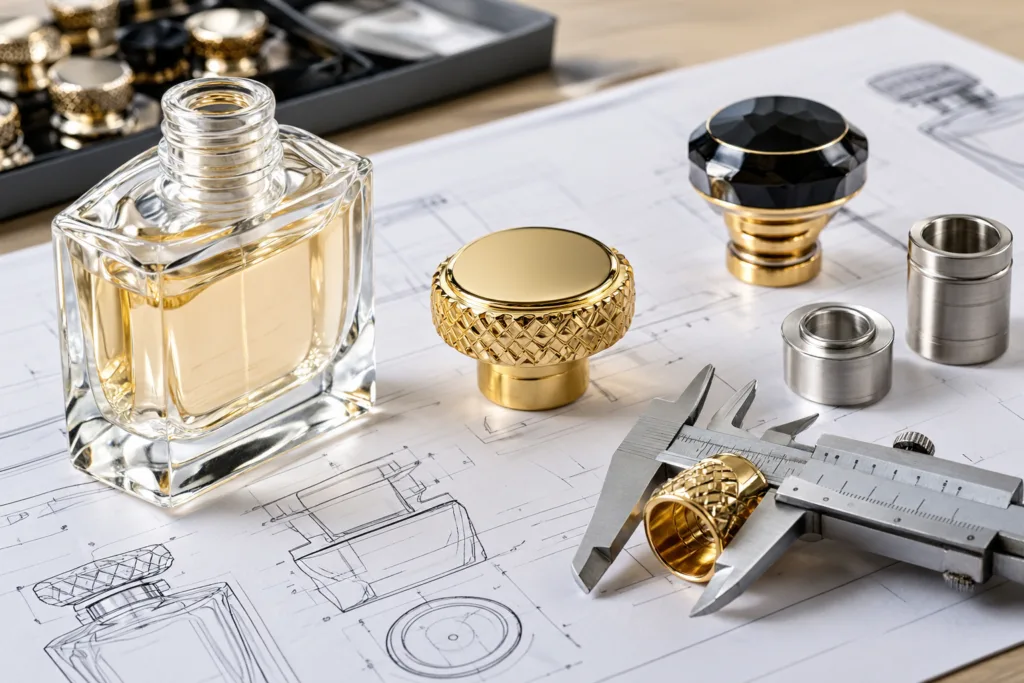
Bottle dimensions and neck finish
The first thing every supplier must understand is the bottle interface. A decorative cap can look excellent in rendering and still fail in production if the bottle neck, collar, crimp area, or insert dimensions are not clearly confirmed.
Buyers should provide a bottle drawing whenever possible, along with a physical bottle sample if the project is moving beyond early concept stage. If the bottle is still under development, say that clearly. A quotation based on an unconfirmed bottle is different from a quotation based on a validated bottle sample.
We recommend including the following fit-related information in the RFQ:
- Bottle neck outer diameter and critical height dimensions
- Neck finish details, collar geometry, and any overcap stop point
- Pump or collar dimensions if the cap covers assembled components
- Required insertion force, pull-off expectation, or opening feel if known
- Whether the cap uses a plastic insert, metal shell with insert, or full metal structure
- Any alignment requirement between cap logo and bottle decoration
Fit should also be described with tolerances, not only nominal dimensions. In practical manufacturing, a 1 mm design sketch is not enough to control assembly behavior. Suppliers need measurable targets for the insert area, neck interface, and concentricity-sensitive features. That is why RFQs should define dimensional tolerances and fit validation requirements when fit is critical to cap performance and visual alignment.
When buyers are unsure what to send, it helps to ask for a fit review early. This is where bottle fit engineering for custom perfume caps becomes important, because the cap shell design, insert design, and neck interface cannot be quoted accurately as separate issues.
| RFQ Item | Why It Matters | What to Send |
|---|---|---|
| Bottle neck dimensions | Determines insert and internal cap structure | 2D drawing or measured bottle sample |
| Neck finish and collar details | Affects seating height and assembly compatibility | Technical drawing and photos |
| Pump and crimp area | Prevents interference inside the cap | Assembly drawing or complete bottle set |
| Tolerance expectations | Reduces fit disputes during sampling | Critical dimensions with acceptable range |
| Alignment requirement | Impacts insert orientation and tooling decisions | Logo position reference and bottle artwork reference |
Material, finish, and logo requirements
After fit, the next quotation driver is cap construction. Buyers should state whether they want zinc alloy, plastic, aluminum, or a mixed structure. For premium decorative projects, zinc alloy is often selected because it supports weight, sharp detailing, and a more solid hand feel. It is also well suited to die-cast development for shaped metal caps, as explained in this technical overview of zinc alloy die casting advantages for decorative metal caps.
But material should not be chosen by appearance alone. A heavier cap may improve premium perception, while also increasing tooling complexity, finish preparation time, and shipping cost. If the RFQ simply says “luxury metal cap” without target weight, finish class, and structure, quotations from different suppliers may not be comparable.
At minimum, the RFQ should define:
- Target material or acceptable material options
- Approximate cap weight target if hand feel matters
- Surface finish type such as electroplating, baked paint, brushed effect, polished effect, or matte texture
- Color reference, Pantone reference if applicable, or approved finish sample
- Logo treatment such as engraving, embossing, debossing, laser marking, or filled logo
- Visible cosmetic standard for scratches, pits, color variation, or edge quality
Finish language should be specific. “Gold” can mean bright gold plating, satin champagne gold, painted gold, or a warmer antique tone. Each option uses a different process path and cost basis. The RFQ should also say whether the finish must match an existing component such as a pump collar, bottle decoration, or outer carton foil.
For logo work, drawing position and finish contrast matter as much as the artwork file. Small logos can lose clarity if engraving depth is shallow, if the finish is too reflective, or if the logo sits on a curved face. Buyers comparing quotations should therefore provide vector artwork and ask how the supplier will control sharpness and readability. This is especially important when the project involves fine logo and branding treatments for perfume caps.
| Requirement | Better RFQ Language | Weak RFQ Language |
|---|---|---|
| Material | Zinc alloy outer shell with inner insert | Metal cap |
| Finish | Bright nickel plating with high polish base | Silver finish |
| Paint | Matte black baked paint, low gloss | Black coating |
| Logo | Front-face debossed logo, 0.3 mm depth | Add logo |
| Weight | Approx. 45 to 55 g preferred | Premium feel |
What to ask the supplier before quoting
Good RFQs do not only give information. They also ask the supplier to confirm what is included, what is assumed, and what still needs validation. This is where many sourcing risks can be reduced before sample development begins.
MOQ, lead time, and sample process
Ask for the quotation basis in stages. Buyers often request one price and later discover that mold cost, sample cost, insert development, finish testing, or logo tooling were excluded. A serious supplier should explain which part of the quote covers tooling, sampling, and mass production.
The RFQ should ask the supplier to confirm:
- MOQ for standard production after sample approval
- Whether MOQ changes by finish, color, or logo variation
- Tooling charge and whether it includes insert tooling
- Sample lead time for first prototype and revised sample
- Mass production lead time after approval and deposit
- Whether bottle sample receipt is required before sampling starts
- Whether finish sample and assembly sample are separate stages
Different cap constructions create different lead-time realities. A simple painted cap may move faster than a high-polish plated cap with deep logo detailing and tight fit validation. Buyers should request a process breakdown rather than a single total lead time. This helps sourcing teams compare realistic schedules instead of optimistic ones.
For projects that are still balancing launch timing, budget, and product mix, asking about lead time and MOQ planning for perfume cap production can prevent RFQs from being evaluated on price alone.
Key takeaway: A lower quoted unit price is not necessarily lower total project cost if tooling, revision samples, or finish-related MOQ conditions are missing from the quotation.
QC standards and export capability
Before comparing suppliers, buyers should ask how quality will be measured. “Good quality” is not a production standard. Cosmetic caps need clear acceptance logic for appearance, dimensions, fit, finish adhesion, and packaging condition.
We suggest asking suppliers to define their inspection points for:
- Incoming raw material or die-cast body checks
- Polishing quality before plating or painting
- Color and gloss consistency
- Logo clarity and placement
- Insert fit and pull-off function
- Final assembly compatibility with the bottle
- Packing protection for export shipment
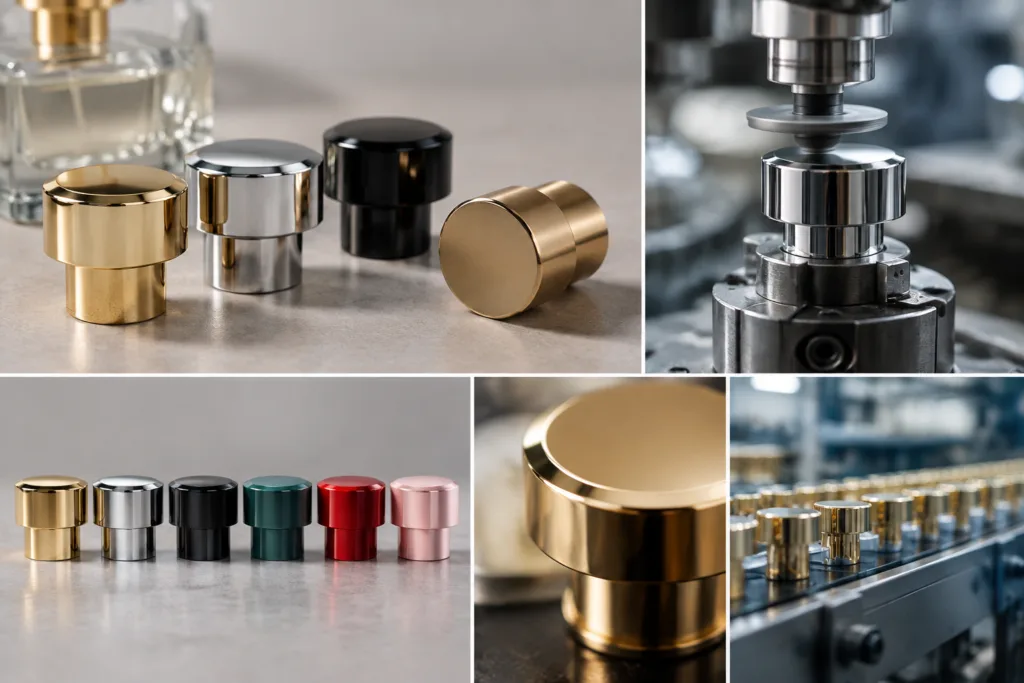
Export packaging also deserves a place in the RFQ. Decorative metal caps can scratch, rub, dent, or mark one another during transit if inner packing is not defined. Tray loading, partition method, polybag use, foam protection, carton strength, and pallet condition can all affect delivered quality. Buyers shipping internationally should ask for export packaging and transit protection requirements for finished caps to be reflected in the quotation basis, especially for plated or polished parts.
In supplier review, we also encourage buyers to ask how bulk production is monitored. The answer should reference dimensional checks, appearance control, assembly checks, and pre-shipment inspection, not only “100% inspection” as a generic phrase. This is why it is useful to review a supplier’s quality control checkpoints for perfume cap orders before awarding a project.
| Question to Ask | Why It Reduces Risk |
|---|---|
| What cosmetic defects are acceptable? | Prevents appearance disputes after bulk delivery |
| How is fit checked during production? | Confirms bottle compatibility is not sample-only |
| What packing method is included? | Protects plated and painted surfaces in transit |
| Will a golden sample or approval standard be kept? | Improves consistency across production lots |
| What reports or photos are provided before shipment? | Improves remote approval and export visibility |
How to compare supplier quotations fairly
The right comparison method is simple: compare scope, not price line alone. Two quotations may describe the same cap concept but include different assumptions about material grade, cap weight, insert type, finishing steps, sampling rounds, and inspection standard. If those assumptions differ, the prices are not directly comparable.
Scope alignment and hidden costs
Start by checking whether each supplier is quoting the same cap structure. One supplier may quote a zinc alloy shell with a custom insert, while another quotes a lighter cap with a standard insert adapted later. One may include polishing and topcoat protection, while another prices only the visual finish.
Ask each supplier to break the quotation into comparable components:
- Tooling or mold cost
- Sample charge and number of rounds included
- Unit price at stated MOQ
- Finish surcharge if color or plating changes
- Insert development or fit-test cost
- Packing method included in unit price
- Freight terms and export support assumptions
From our production perspective, hidden costs often appear in three places: fit revision, finish adjustment, and packaging protection. These are not unusual problems. They usually come from RFQs that were too general, not from bad intent on either side.
It also helps to ask whether the supplier is quoting on confirmed or assumed bottle data. If the bottle sample has not been received, the quote should say that fit-related changes may affect tooling or insert cost later.
Sample and tooling assumptions
Tooling assumptions can change the economics of a project quickly. A cap with complex faceting, deep undercuts, fine logo relief, or unusual top geometry may need a more advanced mold solution than a simple round cap. If buyers send only reference images, the supplier may estimate tooling conservatively or incompletely.
To compare quotes fairly, ask each supplier:
- What drawings or 3D files are required before tooling starts?
- What parts of the cap are custom tooled?
- Is the insert custom developed or adapted from an existing structure?
- How many sample revisions are assumed in the quoted plan?
- What happens if bottle fit changes after the first sample?
- Is finish development included before final color approval?
At Caps Ltd, we find that quotation quality improves when buyers distinguish between concept pricing and production-ready pricing. Concept pricing is useful early, but it should not be mistaken for a final sourcing decision if bottle dimensions, cap section data, finish standards, or artwork details are still open.
| Quotation Area | What Buyers Should Compare | Common Hidden Gap |
|---|---|---|
| Tooling | Cap mold scope, insert tooling, logo tooling | Insert or logo tooling excluded |
| Sampling | Prototype type and revision rounds | Only one sample round included |
| Unit price | MOQ basis and finish basis | Price valid only for simple finish |
| Quality standard | Appearance, fit, and inspection criteria | No measurable acceptance standard |
| Packing | Tray, partition, polybag, carton method | Bulk packed parts at risk of scratches |
What a buyer-ready RFQ package should contain
If your team wants faster and more consistent quotations, send one organized package instead of separate messages over time. That package does not need to be complicated, but it should be complete enough for engineering, costing, and production review.
A practical RFQ package usually includes:
- Project brief with target market, launch timing, and order expectation
- Bottle drawing and, if possible, bottle sample
- Cap reference drawing, sketch, or 3D file
- Target material and finish description
- Logo artwork in vector format
- Estimated annual quantity and first order quantity
- Sampling expectations and approval timeline
- Packing and shipping destination information
- Required tests, cosmetic standard, or approval criteria
If any part is not final, say so clearly. A supplier can quote with assumptions, but only when assumptions are visible. That transparency helps both sides manage revision risk and cost changes responsibly.
Key takeaway: The best RFQ is not the longest one. It is the one that tells the supplier what is confirmed, what is flexible, and what must not change.
Common RFQ mistakes that create quotation problems later
Most sourcing issues start with one of a few avoidable mistakes. The good news is that they can usually be prevented before sampling begins.
- Quoting from bottle photos only, without dimensions
- Requesting a luxury finish without naming the actual process
- Ignoring cap weight and hand-feel expectations
- Sending logo artwork without scale or placement direction
- Comparing prices from different cap structures as if they were equal
- Assuming sample fit guarantees bulk consistency without QC alignment
- Leaving export packing undefined for plated or polished caps
One mistake we often see is over-focusing on appearance and under-defining function. Decorative metal caps are visual parts, but they also have to assemble correctly, open properly, survive transport, and remain consistent across production. A sourcing decision should reflect all of those needs.
How fragrance brands can use RFQs to evaluate suppliers, not just prices

An RFQ is also a supplier evaluation tool. The quality of the response tells you a lot about how the manufacturer thinks. If a supplier asks detailed questions about fit, finish, logo depth, insert structure, and packaging method, that is usually a good sign that they understand production reality.
Look for quotations that are clear about assumptions, limits, and validation steps. Better suppliers do not hide uncertainty. They identify it early, explain what needs confirmation, and show how sampling and QC will reduce risk before bulk production.
That is especially important for private label fragrance programs and distributor-led projects, where the buyer may coordinate bottle vendor, pump vendor, carton vendor, and cap supplier at the same time. The cap quotation should support cross-supplier alignment, not become a separate source of ambiguity.
Conclusion
A well-written RFQ for a custom perfume bottle cap helps buyers get more accurate pricing, more realistic lead times, and fewer surprises during sampling and production. The core principle is simple: define the bottle interface, cap material, finish target, logo treatment, tooling assumptions, quality standard, and packing method before comparing quotations.
From our experience as a decorative metal cap manufacturer, the most efficient sourcing projects are the ones where the RFQ acts as a technical brief, not just a price request. When brands and procurement teams make the quotation basis clear, suppliers can quote more honestly, sample more efficiently, and produce with fewer avoidable revisions.
FAQs
What is the most important detail to include in an RFQ for a custom perfume bottle cap?
The most important detail is the bottle fit information, because the cap cannot be quoted accurately without knowing the neck, collar, and internal interface it must match. Even a beautiful cap design can fail if the insert structure or seating height is based on assumed bottle dimensions.
Should I send only reference photos if my cap design is still early?
You can send reference photos for concept pricing, but you should clearly state that the quote is preliminary. For a more reliable quotation, suppliers need dimensions, bottle data, finish expectations, and at least a basic drawing or 3D concept to reduce guesswork.
How specific should finish requirements be in the RFQ?
Finish requirements should be very specific, because terms like gold, matte, or luxury can mean different processes and cost levels. It is better to describe the process type, gloss level, color reference, texture expectation, and any match requirement to other packaging components.
Why do different suppliers quote very different prices for a similar-looking cap?
Different prices usually come from different assumptions about material, cap weight, tooling scope, insert design, finish process, packing method, or included sample work. Buyers should compare quotation scope line by line before deciding that one supplier is simply cheaper than another.
What should I ask about sampling before approving a quotation?
You should ask what type of sample is included, how many revisions are allowed, whether bottle samples are required first, and what happens if fit or finish changes after initial review. This helps you understand whether the quoted development path is realistic or likely to create extra cost later.
How can I reduce sourcing risk when comparing custom perfume cap manufacturers?
You can reduce sourcing risk by sending a complete RFQ, aligning quotation assumptions, checking QC and packing standards, and confirming how the supplier validates fit and finish before mass production. A supplier that explains its process clearly is usually easier to work with than one that responds with price alone.