
A perfume bottle cap sample is not just a visual preview. It is the buyer’s best chance to confirm fit, weight, finish, branding, and packaging requirements before mold confirmation and bulk production begin. For fragrance brands, private label teams, and procurement managers, a disciplined sample approval process reduces avoidable risks such as loose fit, color mismatch, logo softness, scratching in transit, or delays caused by late design changes.
If your project needs reliable perfume cap sample development support, the most useful approach is to review the sample as a manufacturing checkpoint rather than a simple design sign-off. At this stage, we typically help buyers align cap structure, bottle compatibility, decorative finish, logo treatment, sample presentation, and approval standards so the sample can become a realistic reference for tooling confirmation, quality control, and production planning.
From our custom metal cap manufacturing perspective, sample approval works best when buyers know exactly what must be checked and what must be documented. A cap can look impressive in a photo and still fail in production if the insert structure, neck grip, coating durability, or packing method were never properly approved. That is why the sample review should combine visual judgment with measurable technical checkpoints.
Why a perfume bottle cap sample matters more than many buyers expect
The sample stage decides whether the custom cap can be repeated consistently. Once mold development, finishing setup, and mass production scheduling move forward, late changes become more expensive and more disruptive.
For decorative metal caps, especially zinc alloy designs, the sample does several jobs at once. It helps verify the premium hand feel, confirms decorative intent, checks fit with the glass bottle, and reveals whether the approved appearance can be manufactured with stable process control.
Key takeaway: Buyers should approve a sample as a production reference, not only as a design concept.
In practice, a strong sample review answers these questions:
- Does the cap fit the actual bottle correctly?
- Does the weight feel right for the target positioning?
- Does the finish match the approved color and gloss expectations?
- Is the logo sharp, centered, and readable?
- Can the approved result be repeated in bulk with reasonable tolerance and finish consistency?
- Has the packaging method been checked to protect the finish during shipment?
When buyers skip these questions, they often approve too early. The result can be repeated sample revisions, tooling changes, or inconsistent bulk goods that do not match the original visual intent.
What should be included in a perfume cap sample review
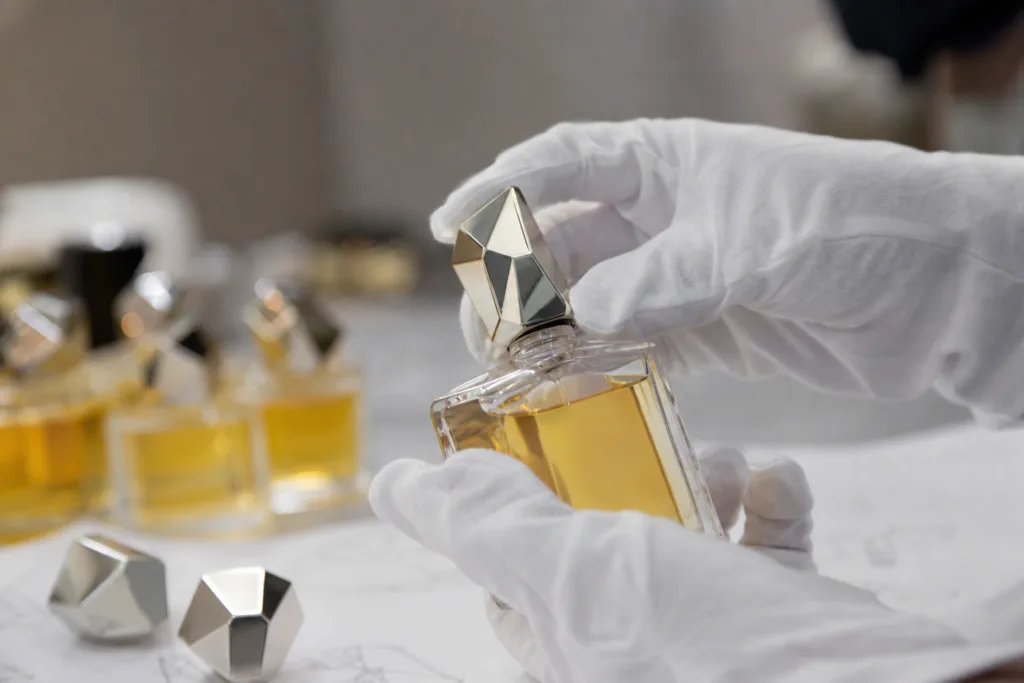
The review should include visual, functional, dimensional, and packaging checks. Looking only at color or shape is not enough for a custom decorative metal cap.
Appearance, fit, and finish checks
Start with what the buyer sees and touches first. A luxury cap should feel balanced, sit correctly on the bottle, and show a clean finish under normal handling and close inspection.
For fit-related development, we recommend confirming the actual bottle sample early and reviewing bottle fit engineering for custom perfume caps before final approval. Small differences in neck diameter, collar height, insert compression, or engagement depth can change how securely the cap sits and how smoothly it assembles.
The main appearance and fit checks usually include:
- Overall cap shape, proportion, and profile
- Surface smoothness after polishing
- Uniformity of electroplated or painted finish
- Weight and hand feel relative to brand positioning
- Top and side alignment when assembled on the bottle
- Insert grip and pull-off feel
- Absence of rattling, tilt, looseness, or excessive tightness
- Logo position, depth, and contrast
For metal caps, finish quality starts before plating or painting. If the die-cast base has visible pits, polishing lines, or edge inconsistency, those defects often remain visible after decorative finishing. Electroplated caps can especially reveal surface preparation problems because reflective finishes show defects more clearly than matte or textured coatings.
That is why we encourage buyers to review not only the final color but also the overall finish standard. A bright gold cap, a brushed silver cap, and a painted matte black cap all require different expectations for defect visibility, gloss, and edge crispness.
| Review item | What to check | Why it matters |
|---|---|---|
| Shape and proportion | Matches approved drawing or 3D concept | Prevents late aesthetic changes after tooling |
| Weight and hand feel | Feels appropriate for target market | Supports premium packaging perception |
| Fit on bottle | Secure, centered, repeatable assembly | Reduces assembly complaints and retail quality issues |
| Surface finish | Color, gloss, texture, uniformity | Defines shelf presentation and brand consistency |
| Logo treatment | Clarity, depth, edge quality, placement | Protects brand identity and readability |
| Handling condition | No easy scratches, chips, or marks | Improves usability and transport resistance |
Buyers often ask whether electroplating or painted finish is easier to approve. The answer depends on the brand target. Electroplating usually offers a stronger metallic effect and premium visual depth, while painted finishes can deliver more flexible color matching and softer visual styles. Approval standards should reflect those differences.
When comparing finish options, it helps to request controlled review criteria and, where needed, use surface finish testing for appearance and finish approval so that sample comments are based on agreed quality points rather than subjective impressions alone.
Packaging and presentation requirements
Sample approval should also include how the cap is packed, protected, and presented. This is often overlooked until the first shipment arrives with rubbing marks, logo abrasion, or mixed orientation.
Decorative metal caps need packing methods that match the finish sensitivity. High-gloss electroplated caps may require more protective separation than textured painted caps. Heavier caps may also need stronger tray support or divider structure to avoid impact damage during transit.
Packaging review should cover:
- Individual or tray-based protection method
- Layer separation to prevent cap-to-cap contact
- Orientation requirements if logo direction matters
- Labeling or batch identification if needed
- Assembly presentation for brand or distributor review
- Outer carton protection for export handling
For projects with retail presentation or distributor handling needs, it is smart to define packaging and assembly requirements for cap presentation during the sample stage, not after bulk production starts. This helps ensure the approved cap arrives in the same visual condition that the buyer signed off on.
Key takeaway: A cap sample should be approved together with its packing logic when the finish is delicate, the cap is heavy, or the logo orientation matters.
How to evaluate sample consistency
A single attractive sample is not enough. Buyers need to know whether the approved result can be repeated with stable dimensions and repeatable appearance. Sample consistency review is where commercial decisions become more reliable.
Dimensional verification
Dimensional approval is essential for any fit-critical cap. Visual approval alone cannot confirm whether the inner diameter, insert cavity, neck engagement depth, or assembly alignment surfaces are controlled tightly enough for production repetition.
From our manufacturing side, the most important dimensions are usually the ones hidden inside the cap rather than the decorative outer shape. A cap may appear correct externally but still grip too tightly, sit too high, or wobble because of minor variation in internal structure.
This is why buyers should review drawings, sample measurements, and fit-critical checkpoints using dimensional and geometrical tolerancing principles for fit-critical parts when the project requires dependable bottle compatibility. In practical terms, the approved sample should be linked to measurable tolerances so the same fit behavior can be checked again during production.
Common dimensions to confirm include:
- Cap inner diameter
- Insert cavity size and depth
- Total cap height
- Bottle engagement depth
- Wall thickness in fit-critical areas
- Top surface flatness or alignment reference
- Logo location relative to bottle front orientation
For procurement teams, the safest path is to sign off on both the physical sample and the drawing or measurement sheet. That way, quality control has an objective reference instead of relying on memory or photos.
| Dimension area | Typical approval focus | Possible risk if skipped |
|---|---|---|
| Inner fit diameter | Grip and assembly compatibility | Loose cap or over-tight fit |
| Insert depth | Neck engagement position | Cap sits too high or too low |
| Overall height | Visual proportion on bottle | Mismatch with approved silhouette |
| Alignment surfaces | Centering and orientation | Visible tilt or inconsistent logo facing |
| Wall and cavity consistency | Structural repeatability | Variation across production lots |
Functional and visual comparison to reference
Once dimensions are verified, the next step is comparison to the approved reference. Buyers should compare the sample against artwork files, finish chips, 3D drawings, bottle samples, and any approved logo renderings. The point is to confirm that all project references tell the same story.
At this stage, we usually advise buyers to review at least three kinds of consistency:
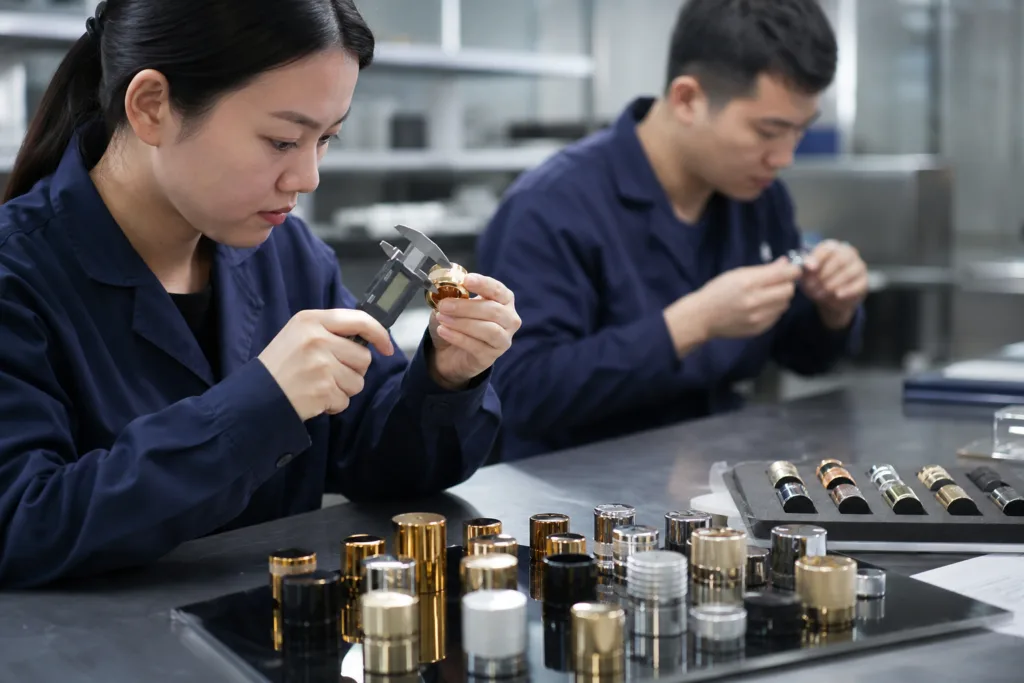
- Consistency against the approved design intent
- Consistency between multiple sample pieces if more than one is available
- Consistency between the cap and the actual bottle or full pack presentation
A useful review question is simple: if this sample becomes the production benchmark, would the buyer be comfortable receiving thousands of units that look and function like this? If the answer is uncertain, approval is not ready.
Visual comparison should include:
- Color tone under standard viewing conditions
- Gloss or matte level
- Reflectivity for electroplated surfaces
- Texture consistency for painted or coated finishes
- Logo sharpness and line cleanliness
- Gap appearance between cap and bottle collar
- Balance of cap size versus bottle body
Functional comparison should include repeated on-off testing on the real bottle. A cap that feels correct once may behave differently after repeated assembly if the insert is too aggressive or the tolerance window is too narrow.
Key takeaway: The best sample approval compares the cap to both visual references and repeated real-use behavior on the target bottle.
What buyers often miss during sample approval
Most approval mistakes are not dramatic. They are small details that seem manageable during sampling but become expensive when multiplied across a production run.
The most common missed items include:
- Approving color without defining acceptable variation
- Approving fit without using the real bottle sample
- Approving logo artwork without checking final metal depth and visibility
- Ignoring edge feel, burr risk, or polishing marks
- Skipping packaging protection review for glossy finishes
- Not confirming sample weight target
- Signing off without a measurement-based reference
- Reviewing only one sample piece and assuming production consistency
From our experience, the biggest issue is often unclear approval language. Comments such as “looks good” or “please improve fit slightly” are too vague to guide production. Clear sample approval should identify what is accepted, what must change, and what tolerance or finish standard applies.
| Common mistake | Likely consequence | Better approval approach |
|---|---|---|
| Visual-only approval | Fit problems in production | Approve with dimensions and bottle test |
| No finish benchmark | Color or gloss disputes | Approve against a defined reference |
| No logo standard | Soft or inconsistent branding | Confirm depth, placement, and contrast |
| No packaging check | Transit scratches or rubbing | Approve cap and protective packing together |
| No repeat test | Assembly inconsistency | Test multiple on-off cycles on real bottle |
What happens after sample approval
After approval, the project moves from evaluation into execution. This is the stage where confirmed decisions should be translated into tooling, production planning, inspection standards, and schedule control.
Tooling confirmation and bulk production planning
Once the perfume bottle cap sample is approved, tooling confirmation can move forward based on the signed reference. For custom zinc alloy caps, this usually means locking the external form, confirming internal fit geometry, and aligning finishing and logo processes with the approved sample standard.
At this point, our team treats the sample as a manufacturing baseline. We compare the approved piece, drawing details, bottle fit notes, finish expectations, and packing method so that the production route is built around documented decisions rather than assumptions.
If the next step is production readiness, buyers should review bulk production planning after sample approval carefully. This stage affects how finishing batches are organized, how inspection limits are set, and how realistic the delivery schedule will be once volume, complexity, and packaging requirements are confirmed.
Production planning after approval usually includes:
- Final mold or tooling confirmation
- Insert specification lock
- Finish process confirmation such as plating or baked paint
- Logo process confirmation such as engraving, embossing, or debossing
- Inspection criteria linked to the approved sample
- Packing method approval
- Volume and batch planning
This is also the right point to involve Caps Ltd or another manufacturing partner in a detailed review of production practicality. Some cap designs are visually excellent but require adjustments for better stability, better edge quality, or more repeatable assembly in volume.
Lead time and export scheduling
Sample approval directly affects lead time. The clearer the approval package, the easier it is to plan production, quality checks, and export logistics without avoidable rework.
Lead time is not only about factory production days. Buyers should also consider bottle arrival timing, insert sourcing, finishing queue time, sample revision history, final inspection, and shipment preparation. If launch timing is important, these details should be discussed immediately after approval rather than near the shipment date.
For export projects, the schedule should also allow time for finish protection, carton preparation, pallet planning where needed, and destination-specific documentation if the buyer requires it. Heavy decorative caps are durable in structure, but premium finishes still need careful handling to reach the destination in approved condition.
Key takeaway: The faster a buyer turns sample approval into documented production instructions, the lower the risk of delay, rework, and shipment inconsistency.
A practical approval checklist buyers can use before sign-off
Before approving a sample, we recommend a final structured check. This gives fragrance packaging teams, sourcing managers, and private label buyers a consistent decision framework.
- Confirm the sample fits the actual bottle sample correctly
- Check cap height, seating position, and visual alignment on the bottle
- Confirm weight and hand feel match brand expectations
- Review finish uniformity under normal and close inspection
- Check logo clarity, placement, and contrast
- Review internal dimensions or measurement sheet for fit-critical features
- Test repeated assembly and removal
- Approve protective packaging method for the finish type
- Record any accepted variation or special appearance notes
- Confirm the approved sample will be the production reference
This checklist is especially valuable for private label perfume projects where multiple teams may review the same cap. Clear sign-off reduces misunderstandings between brand, distributor, procurement, and factory teams.
How we recommend documenting final approval
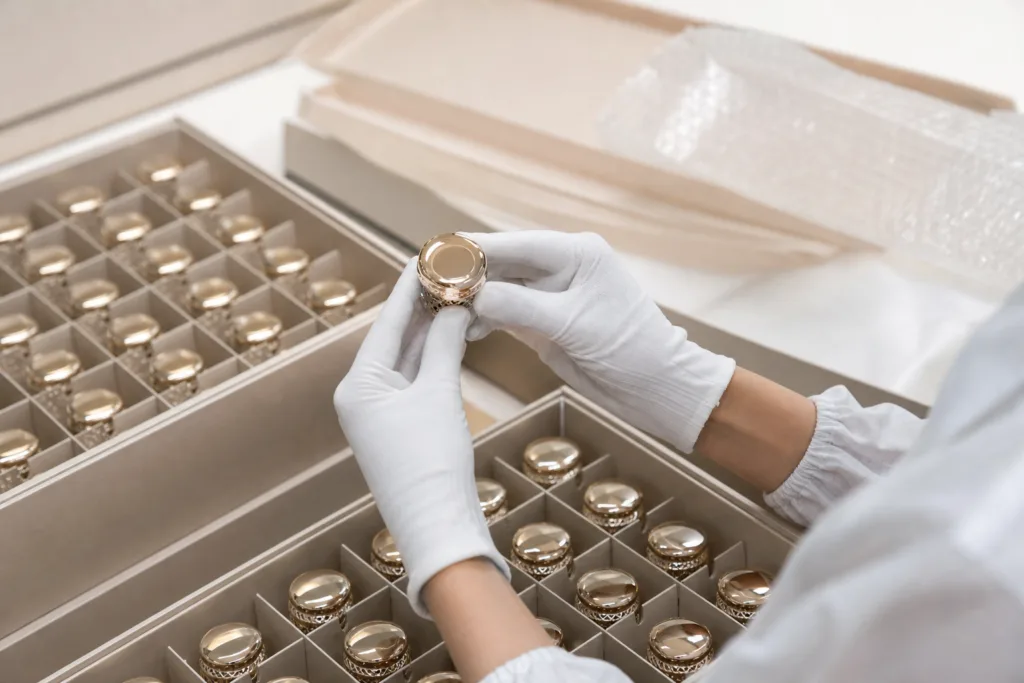
The strongest approval package is simple but specific. It should include the approved physical sample, a dated approval note, key dimensions or a drawing reference, bottle reference confirmation, finish description, logo confirmation, and packing instructions.
Where possible, buyers should also note which variations are acceptable and which are not. For example, a matte painted cap may allow slight visual softness that would be unacceptable on a mirror electroplated cap. Defining that early helps quality teams inspect the product fairly and consistently.
At Caps Ltd, we find that projects move more smoothly when sample comments are converted into short approval standards instead of informal email remarks. Even a brief written checklist improves consistency once the project reaches volume manufacturing.
Conclusion
The perfume bottle cap sample stage is where product vision meets manufacturing reality. Buyers who review appearance, fit, dimensions, logo detail, finish durability, and protective packaging together are much more likely to receive bulk goods that match expectations.
A good sample approval process does not need to be complicated, but it does need to be disciplined. If the perfume bottle cap sample is treated as a measurable production reference, not only as a design preview, fragrance brands and sourcing teams can reduce risk, protect launch timing, and build more reliable communication with their manufacturing partner.
FAQs
What should a buyer approve on a perfume bottle cap sample before mass production?
A buyer should approve fit, dimensions, finish, logo quality, weight, and packaging protection before mass production. The sample should also be checked on the real bottle so the approved cap becomes a realistic reference for tooling, inspection, and bulk production consistency.
Is visual approval enough for a custom metal perfume cap sample?
No, visual approval is not enough for a custom metal perfume cap sample. A cap can look correct while still having hidden fit or tolerance problems, so buyers should confirm measurable internal dimensions, bottle engagement, and repeat assembly performance in addition to appearance.
How many sample pieces should buyers review when possible?
Buyers should review more than one sample piece when possible because a single piece does not show repeatability. Comparing multiple samples helps reveal variation in finish, logo clarity, weight balance, and fit behavior before production standards are locked.
What is the most common reason a perfume cap sample fails after bulk production starts?
The most common reason is unclear approval criteria rather than one major manufacturing defect. When fit limits, finish standards, logo expectations, or packing requirements are not clearly defined, the approved sample becomes difficult to reproduce and inspect consistently in bulk.
Should buyers approve cap packaging during the sample stage?
Yes, buyers should approve cap packaging during the sample stage if the cap has a delicate finish, high weight, or orientation-sensitive logo. Protective packing affects how well the approved appearance survives handling, export transit, and warehouse movement.
What happens after a perfume bottle cap sample is approved?
After a perfume bottle cap sample is approved, the project should move into tooling confirmation, production planning, inspection standard setup, and lead time scheduling. This is also the point where the approved sample, drawing details, and packing method should be documented as the production benchmark.