
Perfume bottle cap quality control matters long before bulk production starts. For fragrance brands, private label teams, and packaging buyers, a cap is not only a decorative component. It affects visual presentation, hand feel, bottle fit, opening experience, and the consistency of the finished pack on the shelf. When quality control is weak, the most common problems are visible finish defects, loose or tight fit, logo inconsistency, damaged inserts, and unstable production appearance from one batch to the next.
If your project involves decorative metal caps, custom shapes, plated finishes, or private label fragrance packaging, our perfume cap quality control support is built around practical manufacturing checkpoints. We help buyers review cap structure, confirm bottle compatibility, define finish approval standards, validate samples, and reduce bulk-order risk through production-stage inspection logic that matches real fragrance packaging requirements.
What perfume bottle cap quality control should cover from the start
The short answer is this: buyers should not inspect only the final appearance. Effective perfume bottle cap quality control must cover material, structure, fit, finish, branding details, and packaging protection as one connected system.
From our manufacturing perspective, the cap should be evaluated in the same way it will be used in the market. A cap may look acceptable as a loose component but still fail in assembly if the insert is unstable, the bottle neck tolerance was not reviewed, or the finish is too delicate for normal handling. This is why quality control should begin with a clear specification, not with a visual judgment at the end.
- Confirm the cap material and structural design before sampling.
- Define bottle neck, collar, and insert compatibility early.
- Approve finish standards with realistic sample references.
- Review logo position, depth, and readability under the chosen finish.
- Set inspection points for appearance, dimensions, assembly, and packaging.
- Match approval criteria to bulk production capability, not to one unusually perfect sample.
Key takeaway: The best way to reduce quality problems is to treat the cap as an engineered packaging component, not just a decorative accessory.
Key quality checks for perfume bottle caps
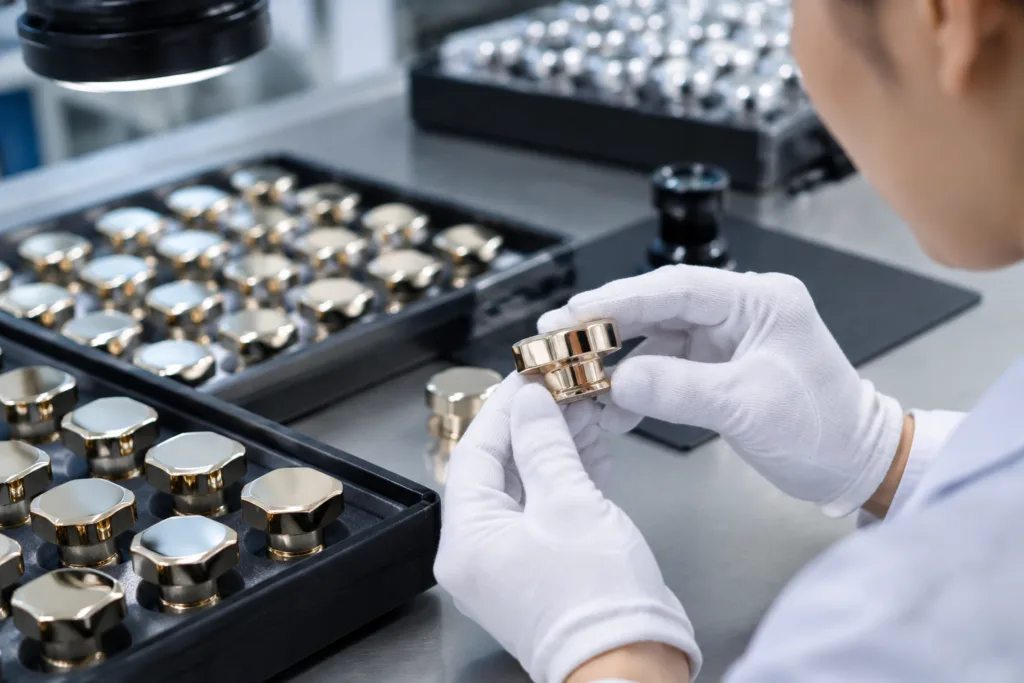
Appearance and surface defects
Appearance is usually the first thing buyers notice, and it should be inspected systematically. On decorative metal perfume caps, the most visible risks include scratches, pits, polishing waves, dust under coating, plating stains, uneven paint coverage, edge exposure, and inconsistent gloss.
The important point is that many finish defects begin before finishing. If the zinc alloy surface is not cast cleanly, polished evenly, or prepared correctly, electroplating will highlight the defect rather than hide it. Painted finishes can also magnify surface irregularities, especially on flat top areas and logo panels.
That is why we recommend checking sample caps under stable lighting from several angles. A buyer should not evaluate only the best-looking face of the part. Rotate the cap and inspect top surfaces, side walls, edges, corners, logo zones, and the interior opening where assembly marks may appear.
| Inspection item | What to check | Why it matters |
|---|---|---|
| Surface smoothness | Pits, dents, polishing marks, roughness | Affects premium appearance and finish quality |
| Coating or plating coverage | Thin areas, exposed base metal, uneven color | Creates visible inconsistency in retail presentation |
| Edge condition | Sharp edges, paint pullback, burrs | Impacts hand feel and perceived quality |
| Logo zone clarity | Blurry lines, weak contrast, fill defects | Reduces branding impact |
| Cleanliness | Dust, fingerprints, residue, trapped particles | Can lead to rejection even when structure is correct |
For metal caps with plating or paint, durability expectations should also be discussed during approval. Buyers often benefit from asking how the manufacturer performs surface finish testing for decorative caps so visual approval is supported by practical handling and adhesion checks, not only by appearance photos.
Fit, assembly, and closure performance
Fit is one of the most overlooked quality issues in fragrance packaging. A cap can look excellent and still fail the project if it wobbles on the bottle, grips too tightly, scratches the collar, or pulls off the actuator incorrectly.
In perfume packaging, fit depends on the full assembly relationship: bottle neck dimensions, collar dimensions, insert material, insert geometry, cap inner diameter, and cap weight. Heavy metal caps require especially careful fit control because extra weight changes how the cap seats and how the user experiences removal and replacement.
When buyers evaluate fit, they should test more than one bottle and more than one cap. This helps reveal whether the assembly works consistently across normal production variation. In custom projects, we usually recommend early review of bottle drawings and physical bottle samples, because good fit is not achieved by cap dimensions alone. It comes from coordinated bottle fit engineering support between the cap structure and the bottle package.
- Check insertion force and removal feel.
- Confirm the cap sits straight without tilt.
- Test whether the cap contacts the bottle or collar in unintended areas.
- Verify no excessive looseness, rotation, or rattle.
- Inspect insert retention after repeated opening and closing.
- Confirm compatibility with the pump and collar assembly.
If the cap is decorative and heavy, balance matters too. A cap that is top-heavy or poorly centered may feel unstable even when it technically fits. That affects user perception and can create transport risk during export packaging.
Why metal cap structure and tolerances affect QC results
For zinc alloy perfume caps, quality control begins at the casting stage. If the base metal part is inconsistent in dimension or surface density, later polishing, plating, assembly, and fit performance all become harder to stabilize. This is one reason why buyers should ask about dimensional control before discussing finish perfection.
Industry references on die-casting tolerances and quality assurance provisions for metal components are useful because they show how casting quality, tolerances, and inspection standards affect the reliability of downstream decorative parts. In practice, this means a fragrance cap supplier should understand not only appearance inspection, but also how casting variation can influence insert fit, logo sharpness, wall thickness, and assembly consistency.
At Caps Ltd, we treat decorative finish quality as the result of correct upstream control. A smooth plated cap starts with proper mold design, stable die casting, consistent trimming, and disciplined surface preparation. Buyers comparing suppliers should keep this in mind: a factory that talks only about final color may not be controlling the actual causes of defect.
Common production defects buyers should watch for
Color variation and scratches
Color variation is a major reason for sample approval disputes and bulk shipment complaints. The problem is not limited to obvious shade mismatch. In metal caps, variation may appear as gloss difference, tone shift between batches, inconsistent reflectivity, or visible contrast between the body and top piece of a multi-part cap.
Electroplated finishes are sensitive to polishing consistency, bath condition, and part loading during processing. Painted finishes are sensitive to paint viscosity, spray control, oven conditions, and substrate cleanliness. Because of this, buyers should define what color approval means in practical terms: visual match to a retained standard sample, acceptable lot variation, and inspection under agreed lighting conditions.
Where projects require close finish repeatability across multiple orders, it helps to understand how a manufacturer manages color consistency control in cap production. This is especially important for brand collections, gift sets, and private label programs that may reorder the same cap months later.
Scratches are another frequent issue, especially on high-gloss plating and dark painted finishes. Some scratches come from handling after finishing, but others come from poor packaging separation, crowded production trays, or rough contact during assembly. A good supplier should be able to explain not only how scratches are found, but how they are prevented.
| Defect risk | Likely cause | Buyer consequence |
|---|---|---|
| Shade variation | Batch process variation, inconsistent surface prep | Mixed appearance in retail cartons |
| Gloss difference | Uneven polishing or curing conditions | Premium look is reduced |
| Fine scratches | Handling or poor packing protection | Higher rejection during incoming inspection |
| Rub marks | Part-to-part friction in transit | Visible damage on plated or painted caps |
Misalignment and finish inconsistency
Misalignment often appears in custom caps with multiple decorative elements. Examples include off-center logos, top plates not seated evenly, inserts pressed at an angle, and cap shells that appear visually unbalanced on the bottle.
Finish inconsistency can also be structural. If sharp corners are not polished consistently, the final coating may appear thinner on edges. If a logo engraving is too shallow, plating can soften its readability. If embossing is too deep for the finish style, pooling or weak edge definition may result.
Buyers should inspect caps both as loose parts and in full assembly on the bottle. Some alignment problems only become visible when the cap is placed on the pump and collar. A logo that looks centered on the loose cap may not appear centered relative to the bottle front if the fit system was not coordinated.
- Check whether the decorative top is centered.
- View the logo orientation against the front of the bottle.
- Compare multiple pieces side by side for finish uniformity.
- Inspect edge coverage on corners and recessed areas.
- Look for mismatch between cap shell and insert positioning.
Key takeaway: Many defects that appear to be finish problems are actually design, tooling, or assembly-control problems in disguise.
How a manufacturer should manage QC during production
Incoming material checks
Good QC starts with incoming materials, not only with finished caps. For metal perfume caps, incoming checks may include base alloy components, inserts, decorative top parts, paint materials, plating consumables, adhesives where applicable, and packaging materials used to protect finished surfaces.

From our production experience, insert quality deserves special attention. Even when the metal shell looks perfect, poor insert consistency can cause loose fit, over-tight application, cracking, or unstable retention after repeated use. Incoming insert checks should cover size, hardness or flexibility where relevant, and assembly compatibility with the approved cap structure.
Packaging materials also matter more than many buyers expect. If trays, separators, or protective bags are not suitable for the finish, a cap can pass final inspection and still arrive scratched. That is why incoming material control should include the materials used for internal packing and export preparation.
In-process and final inspection
In-process inspection is where preventable defects are caught before they become a full-batch problem. For decorative caps, this usually means checking dimensions after casting or machining, monitoring polishing quality before finishing, verifying finish appearance during production, and reviewing assembly condition during insert fitting and final packing.
A reliable supplier should have more than one inspection gate. If inspection happens only after full production is complete, defect correction becomes slower, more expensive, and less realistic. Buyers should ask where the factory checks dimensions, finish quality, assembly fit, and packed condition.
Final inspection should confirm appearance, dimensions, assembly performance, and packaging readiness according to the approved sample and project standard. If your team is reviewing supplier capability, it is reasonable to ask about their final inspection requirements for perfume caps and how those requirements are documented before shipment.
| QC stage | Main control point | What it prevents |
|---|---|---|
| Incoming | Insert, raw material, packaging material review | Fit failure and transit damage |
| Casting or forming | Dimensional spot checks | Poor assembly compatibility |
| Polishing | Surface smoothness and edge consistency | Visible finish defects later |
| Finishing | Color, gloss, adhesion, coverage checks | Bulk visual inconsistency |
| Assembly | Insert position and cap seating | Loose, tilted, or unstable fit |
| Final packing | Count, protection, carton condition | Shipment damage and mixed lots |
How buyers should approve samples before bulk orders
Sample approval should be specific, documented, and realistic. The most useful sample is not just the nicest-looking piece. It is the sample that clearly defines acceptable production quality for appearance, fit, finish, logo presentation, and assembly feel.
We usually advise buyers to review samples in three ways: as individual loose caps, as assembled caps on actual bottles, and as packed items prepared for shipment. This reveals issues that may otherwise be missed, such as hidden scratches, cap wobble, bottle contact marks, or weak internal packing protection.
- Retain an approved reference sample for future batch comparison.
- Confirm the approved bottle and pump combination used in fit testing.
- Record the finish name, color reference, and logo treatment.
- Note what minor natural variation is acceptable and what is not.
- Align approval comments with production reality rather than subjective preference alone.
If the project is for a new brand launch or a limited-edition collection, sample review should also include carton packing logic and handling risk. High-polish decorative metal caps can be visually sensitive, so protection method is part of quality control, not an afterthought.
Questions procurement teams should ask when evaluating a perfume cap supplier
Supplier evaluation becomes easier when questions are tied to actual risks. Instead of asking whether the factory has quality control, ask how quality is controlled at each stage and how approvals are translated into production instructions.
This is also the point where manufacturer transparency matters. A capable supplier should be able to explain material choice, tooling logic, insert selection, finish limitations, and the likely trade-off between visual ambition and bulk repeatability. Buyers do not need every technical detail, but they do need clear answers.
- How is fit verified against the actual bottle and pump assembly?
- What defects are screened during polishing, finishing, and assembly?
- How are color and gloss standards retained for repeat orders?
- How is logo clarity checked across the full batch?
- What packaging method protects plated or painted surfaces in export transit?
- What sample becomes the working standard for final production approval?
- What is the plan if a finish issue appears during mass production?
In our experience, strong supplier communication reduces more risk than aggressive inspection at the end. Clear bottle samples, artwork files, finish references, quantity expectations, and timeline targets allow the manufacturing team to build realistic controls before problems appear.
Common mistakes that weaken perfume bottle cap quality control
The most common mistake is approving the cap visually without checking functional fit. A decorative cap must work with the bottle, pump, collar, and insert as an assembled package. If that relationship is ignored, bulk issues often appear even when the cap body itself seems well made.
Another mistake is expecting the production lot to match one perfect handmade sample without defining measurable tolerances. Decorative packaging always involves some controlled variation. The practical goal is consistency within an approved range, not an unrealistic zero-variation expectation.
We also see buyers approve color by photo alone. That is risky for plated and painted metal caps because lighting, angle, and reflection change the appearance significantly. Physical retained samples are more reliable for quality alignment.
- Do not skip multi-bottle fit testing.
- Do not approve finish without checking edges and recessed areas.
- Do not judge logo quality only from artwork files.
- Do not ignore packaging protection for glossy surfaces.
- Do not wait until shipment to define acceptance standards.
When heavier decorative metal caps are worth the extra control effort
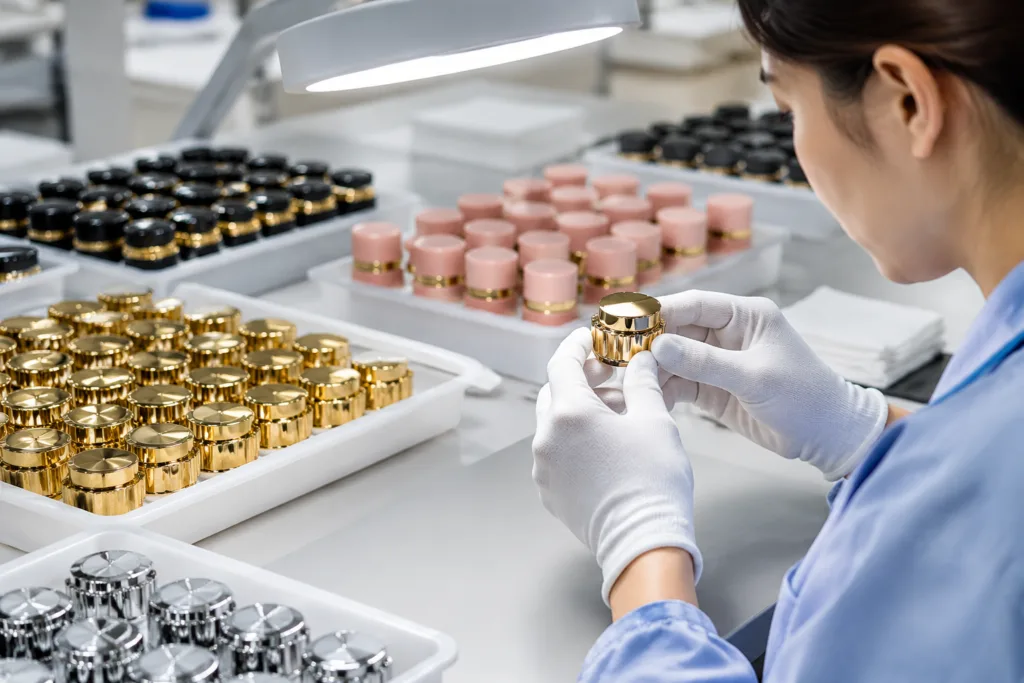
Heavy metal caps can create a stronger premium impression, but they require tighter control. The extra weight affects fit behavior, removal feel, transport protection, and the way users perceive quality. If the bottle is lightweight and the cap is heavy, balance becomes part of the user experience.
For many luxury and niche fragrance projects, zinc alloy remains a strong option because it supports custom shapes, substantial hand feel, and detailed branding treatment. The trade-off is that the project needs disciplined control over tolerances, polishing, finish consistency, and insert design. This is where working with Caps Ltd as a manufacturer can be useful, because we review not only decorative styling but also the fit, finishing route, and production practicality behind the final cap.
Key takeaway: A premium metal cap creates value only when weight, fit, finish, and protection are controlled together.
Conclusion: what good perfume bottle cap quality control really looks like
Good perfume bottle cap quality control is practical, repeatable, and connected to the real use of the packaging. It covers the full path from casting and surface preparation to finish approval, insert assembly, bottle fit, and export packing. For buyers, the goal is not to become engineers. The goal is to ask the right questions, approve the right standards, and work with a manufacturer that can explain how defects are prevented, not just how they are sorted.
For fragrance brands and packaging teams, the safest approach is to align quality expectations early. Confirm the bottle system, define finish standards, inspect real samples carefully, and make sure bulk production control follows the same logic. That is how perfume bottle cap quality control becomes a risk-reduction tool instead of a last-minute inspection exercise.
FAQs
How do I check whether a perfume bottle cap fits correctly?
A correct fit should feel stable, straight, and repeatable across multiple bottles. Buyers should test several cap-and-bottle combinations, check for wobble or tilt, confirm the cap does not scrape unintended surfaces, and review removal force so the cap feels secure without being too tight for normal use.
What are the most common visible defects on decorative metal perfume caps?
The most common visible defects are scratches, color variation, plating stains, dust in coating, polishing marks, weak edge coverage, and unclear logos. These issues affect perceived quality immediately, so inspection should include top surfaces, side walls, edges, recessed areas, and branding zones under stable lighting.
Why can a sample look good but bulk production still have problems?
A sample can look good while bulk production fails if approval standards were incomplete or if upstream controls were weak. Common causes include uncontrolled casting variation, inconsistent polishing, unstable finishing conditions, insert variation, or approval based on one exceptional piece rather than a realistic production standard.
What should buyers confirm before approving a plated or painted cap finish?
Buyers should confirm color reference, gloss level, surface smoothness, edge coverage, logo visibility, and handling durability before approval. It is also wise to review how the finish is inspected in production and how the caps will be packed, because glossy surfaces can be damaged even after passing appearance checks.
How important is insert quality in perfume cap quality control?
Insert quality is critical because it directly affects fit, retention, opening feel, and long-term assembly stability. Even a visually perfect metal shell can create problems if the insert dimensions, material behavior, or assembly position are inconsistent from piece to piece.
What should I ask a perfume cap manufacturer about quality control before placing a bulk order?
You should ask how the factory controls dimensions, polishing quality, finish consistency, insert assembly, bottle fit verification, and packing protection before shipment. A reliable manufacturer should also explain what sample becomes the reference standard, where inspections happen during production, and how nonconforming parts are handled if issues appear.