
US buyers sourcing custom fragrance caps from overseas suppliers should evaluate more than appearance, unit price, and sample photos. When comparing perfume bottle cap manufacturers, the practical questions are whether the supplier can protect the caps during export, control fit and finish consistency, prepare correct shipping documents, and keep the order moving without costly surprises. For fragrance brands, private label teams, and packaging distributors, export readiness is part of product quality because a well-made cap can still become a problem if packaging, paperwork, or shipment coordination is weak.
If your project includes decorative metal caps, custom inserts, logo treatment, or bottle-fit engineering, it helps to review perfume bottle cap development support before requesting quotations. That early review usually clarifies cap material selection, insert structure, bottle neck compatibility, finishing options, mold development scope, and sample expectations, which are all factors that affect export packaging, approval timing, and mass production planning.
A serious supplier evaluation should connect product design with shipment reality. Heavy zinc alloy caps, electroplated surfaces, painted finishes, and tight bottle-neck tolerances all influence how cartons are built, how samples are approved, and how final inspections should be handled before goods leave the factory.
What US buyers should evaluate first when comparing perfume bottle cap manufacturers
The fastest way to compare suppliers is to ask how they manage the full path from drawing to export. A capable manufacturer should be able to explain cap structure, insert selection, finish process, carton protection, inspection method, and shipment document preparation in one clear sequence.
From our manufacturing perspective, the strongest projects are usually the ones where buyers share complete information early. That includes bottle samples or neck drawings, logo files, finish references, target quantity, packing expectations, and preferred shipment terms. Without these basics, pricing may be quick, but risk stays hidden until sampling or shipping.
- Confirm cap material and target weight.
- Confirm bottle neck dimensions, insert type, and fit tolerance.
- Confirm finish type, such as electroplating, painted finish, brushed effect, or polished metal look.
- Confirm logo method, including engraving, embossing, debossing, or printed branding.
- Confirm master carton method, inner protection, and export drop-risk considerations.
- Confirm documentation support for invoice, packing list, and shipment coordination.
- Confirm sample approval standards before bulk production starts.
- Confirm lead time milestones, inspection timing, and dispatch communication.
Key takeaway: A perfume cap supplier is easier to trust when they can explain both manufacturing control and export control in the same conversation.
Export readiness checklist for perfume cap orders
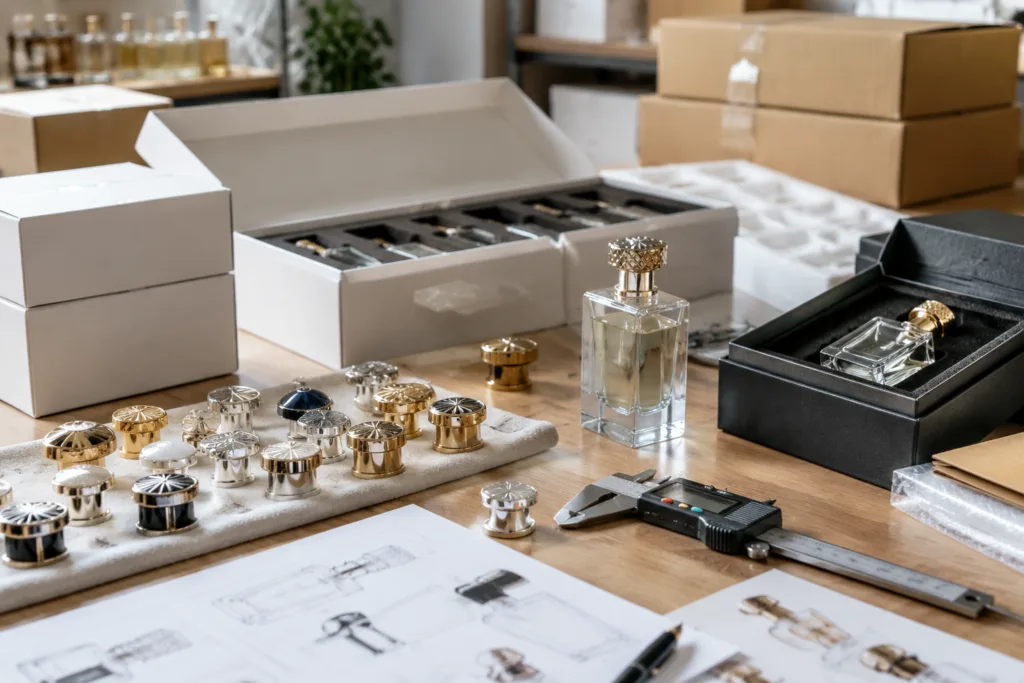
Export readiness means the order is prepared to travel safely, clear documentation accurately, and arrive in a condition that still matches the approved sample. For US buyers, this is especially important when sourcing premium caps with decorative surfaces because freight vibration, compression, humidity exposure, and repacking errors can damage appearance even if production itself was acceptable.
Packaging protection and carton planning
Carton planning should be discussed before mass production is finished, not after. Cap weight, surface finish, logo exposure, and insert structure all affect how pieces should be packed. A heavy metal cap with a polished or electroplated surface needs more thoughtful spacing and internal protection than a lightweight standard cap.
We usually advise buyers to ask for the supplier’s export packaging requirements for perfume cap orders in advance. This helps clarify whether caps are packed in trays, partitioned cells, individual bags, or layered protective formats, and whether carton count and pallet logic are suitable for the shipment method.
For US import planning, buyers should request carton count, unit quantity per carton, net weight, gross weight, carton dimensions, and pallet assumptions before dispatch. The International Trade Administration’s guidance on packing list and carton-level shipment details is useful because it shows why carton counts, measurements, and package-level accuracy matter for freight handling and customs processing.
| Packaging point | Why it matters | What buyers should ask |
|---|---|---|
| Inner protection | Reduces scratching, rubbing, and logo damage | Are caps individually separated or touching each other? |
| Carton strength | Prevents crushing during stacking and transit | What carton grade and stacking method are used? |
| Weight per carton | Affects handling safety and compression risk | How heavy is each carton once packed? |
| Surface protection | Important for plated and painted finishes | Are protective bags, tissue, or trays used? |
| Carton marking | Improves warehouse receiving accuracy | Will cartons show item code, quantity, and batch reference? |
The right packaging method depends on the cap itself. Zinc alloy caps often create a stronger premium hand feel, but they also increase carton load and raise the chance of impact marks if units are packed too tightly. Painted caps may require extra care to avoid edge rubbing, while bright electroplated surfaces can show scratches more visibly under warehouse lighting.
We also recommend asking for packaging photos before the goods ship. This sounds simple, but it often reveals whether the supplier has translated the approved product standard into a realistic export method.
Shipping documents and order coordination
Shipping paperwork should match the physical shipment exactly. If carton quantity, product description, declared value, or shipment references are inconsistent, customs clearance and warehouse receiving can become slower and more expensive.
For US buyers, the supplier should be able to prepare a commercial invoice, packing list, and coordination details that align with the final shipment. The U.S. International Trade Administration explains the commercial invoice requirements for international shipments, which is a helpful reference when checking whether an overseas manufacturer understands document accuracy, valuation details, and consignee information.
In practice, buyers should confirm these document points before dispatch:
- Correct supplier and consignee names
- Clear product description for perfume bottle caps
- Correct quantity, unit price, and total value
- Carton count and gross or net weight consistency
- Shipping marks that match the physical cartons
- Any agreed batch reference, PO number, or item code
Order coordination also matters. A manufacturer may finish production on time but still create delay if document review, pickup booking, or carton marking confirmation happens too late. US buyers should ask who sends shipping documents, who confirms the final carton list, and how changes are handled if quantities shift during final packing.
How US buyers can reduce import risk
Import risk is reduced when the approved sample, production standard, packing method, and dispatch documents are connected as one system. Buyers should avoid treating these as separate steps managed by different people without a final cross-check.
Sample approval before shipment
Sample approval is one of the most effective ways to reduce import problems. A written and visual approval standard gives both the buyer and the factory a reference point for color, finish texture, logo clarity, fit feel, cap weight, and assembly performance.
When teams skip formal approval and move from a rough sample directly into mass production, disagreements usually appear later around acceptable color shift, plating brightness, insert tightness, or minor surface marks. That is why many buyers benefit from reviewing sample approval steps before mass shipment as part of the sourcing process, especially for decorative metal caps with custom branding.
From our experience, a practical approval package often includes:
- Approved cap sample or sealed reference sample
- Bottle fit check with the actual glass bottle or verified neck specification
- Logo position and depth confirmation
- Finish reference under agreed lighting
- Insert material and pull-force expectation
- Packing method confirmation for export
Key takeaway: A good sample does not protect the order unless the approval standard is documented clearly enough to be used in production and final inspection.
| Approval item | What to verify | Risk if skipped |
|---|---|---|
| Bottle fit | Insertion, pull feel, stability, and seating height | Loose caps, tight assembly, or wobble |
| Finish appearance | Color, gloss, texture, and visible defects | Bulk appearance not matching sample |
| Logo treatment | Sharpness, depth, alignment, and contrast | Weak branding impact or unreadable marks |
| Weight and hand feel | Premium feel and ergonomic balance | Product feels lighter or different than expected |
| Packing method | Protection during export transit | Transit scratches and carton damage |
Production and delivery milestones
US buyers should ask for milestone control, not just a promised ship date. A reliable timeline usually breaks the order into mold confirmation, pre-production sample, material preparation, die casting or forming, polishing, finishing, insert assembly, inspection, packing, and dispatch readiness.
This matters because perfume caps are not single-step products. For example, a zinc alloy cap may require die casting, trimming, polishing, surface treatment, logo execution, insert fitting, and final assembly. Delay in one stage can affect the next, especially if color approval or bottle fit correction is still pending.
We advise procurement teams to request milestone updates at a few fixed points:
- After mold or tooling confirmation
- After pre-production sample approval
- When finishing begins
- Before final packing
- When dispatch documents are drafted
This reporting structure reduces surprises and gives buyers time to solve issues before the shipment reaches the warehouse deadline.

What to confirm with a manufacturer before placing an order
Before issuing a purchase order, buyers should confirm the commercial and operational details that affect landed risk. A low quoted price means little if responsibility for export clearance, damage claims, or scheduling gaps is unclear.
Lead time and incoterms
Lead time should be discussed as a sequence, not just a total number of days. Buyers should confirm sample timing, mold timing if applicable, mass production timing, finishing time, final inspection window, and shipment release timing. This is especially important when a cap project includes custom tooling, special color matching, or multiple logo treatments.
It is also worth reviewing lead time and MOQ planning for bulk cap production early, because MOQ, finish complexity, and packaging method can all influence the true production plan.
Incoterms need to be agreed before comparing suppliers on landed cost. The ICC’s explanation of Incoterms rules and risk-transfer responsibilities is useful here because freight cost alone does not define who is responsible for export clearance, main transport, insurance, and certain points of shipment risk.
For US buyers, these are practical questions to ask:
- What is the quoted Incoterm?
- At what point does risk transfer from supplier to buyer?
- Who handles export customs formalities?
- Is palletization included if needed?
- Does the lead time start after deposit, artwork approval, or sample approval?
- How are delays communicated if finishing or assembly runs behind schedule?
At Caps Ltd, we find that many sourcing problems start with vague timelines rather than poor manufacturing ability. Clear milestone language helps buyers compare suppliers on discipline, not only on quotation speed.
Inspection and export communication
Inspection should happen before shipment release, with standards that relate directly to the approved sample and packing method. A supplier that says “we inspect everything” is not giving enough information. Buyers should ask what is checked, when it is checked, and how the results are recorded.
For decorative perfume caps, final control should usually include appearance review, logo clarity, fit check, insert consistency, quantity count, and packaging verification. Buyers looking for stronger shipment confidence should ask about final inspection checkpoints before export so the last control stage is tied to actual export risk, not only basic production completion.
| Inspection area | Why it matters for US buyers | Typical issue if unmanaged |
|---|---|---|
| Dimensions and fit | Ensures compatibility with bottle neck and insert | Assembly failures at filling or packing stage |
| Surface finish | Protects visual quality at retail level | Scratches, color variation, plating inconsistency |
| Logo quality | Maintains brand presentation | Blurred or uneven branding |
| Carton quantity | Supports receiving accuracy and customs records | Short shipment or carton mismatch |
| Packing protection | Prevents transit damage | Caps arrive rubbed, chipped, or dented |
Communication discipline matters as much as inspection itself. Buyers should know who sends production photos, who shares packing confirmation, who issues shipment documents, and how fast corrective updates are provided if an issue appears. Strong export communication is often the difference between a manageable delay and a costly missed launch window.
How cap material and finish affect export planning
Material choice changes both the product experience and the export plan. Zinc alloy is a popular option for premium decorative caps because it supports heavier hand feel, detailed shape development, and a substantial luxury impression. However, the same weight that creates premium perception also requires stronger carton planning and careful inner protection.
Painted and electroplated finishes also behave differently in logistics. Electroplated caps often deliver a more reflective metallic appearance, but surface preparation and polishing quality strongly affect the final look. Painted caps can provide broader color flexibility and softer visual styles, yet edge protection and rub resistance should be considered during packing and handling.
| Cap option | Advantage | Export consideration |
|---|---|---|
| Zinc alloy decorative cap | Premium weight and shape flexibility | Higher carton weight and impact risk |
| Electroplated finish | Bright metallic luxury appearance | Scratches show easily if inner packing is weak |
| Painted finish | Flexible color matching and brand styling | Needs protection against rubbing and edge marks |
| Deep logo engraving | Strong branding durability | Must be checked for clarity after finishing |
| Custom insert fit | Better bottle compatibility | Requires approved bottle sample or exact drawing |
From our decorative metal cap production perspective, buyers should never separate finish choice from logistics planning. The more premium and surface-sensitive the cap, the more important sample approval, packaging confirmation, and final shipment review become.
Common mistakes that create avoidable import problems
The most common import issues are usually preventable. They often begin with assumptions that the supplier understands fragrance packaging standards without receiving enough project detail.
- Approving a cap visually without confirming bottle fit and insert structure
- Comparing prices without comparing Incoterms, packing method, and inspection scope
- Skipping carton photos and assuming export packing is sufficient
- Accepting a finish by phone image only, without agreed approval reference
- Ignoring master carton weight until the shipment is ready
- Failing to align commercial invoice, packing list, and carton marking
- Relying on one final ship date without milestone reporting
These mistakes tend to surface late, when correction is expensive. US buyers can reduce this risk by giving manufacturers a complete brief and asking for confirmation in writing before production begins.
Key takeaway: Most perfume cap import problems are not caused by one big failure. They come from several small unmanaged details that compound near shipment.
A practical supplier evaluation checklist for US fragrance packaging teams

Before placing an order, use a checklist that combines technical capability with export readiness. This makes supplier comparison much more realistic than quoting on appearance alone.
- Can the manufacturer explain cap structure, insert selection, and bottle fit logic clearly?
- Can they support custom mold development if the shape is unique?
- Do they describe finish preparation, polishing, plating, or painting controls in practical terms?
- Can they define sample approval standards for appearance and fit?
- Can they show how the caps will be packed for export?
- Can they provide accurate carton, weight, and shipping document information?
- Do they use milestone-based production updates?
- Is final inspection linked to the approved sample and export packing standard?
If the answer is uncertain on several of these points, the order may still be possible, but the buyer should assume higher coordination effort and higher import risk. Strong manufacturers reduce uncertainty by explaining process details before problems appear.
Conclusion
For US buyers, evaluating perfume bottle cap manufacturers should go beyond cap styling and quoted cost. The better decision is usually the supplier that can connect design, fit, finish, packing, inspection, and export documentation into one controlled workflow. That is what protects launch schedules, import accuracy, and final packaging quality.
From our experience, the most successful fragrance packaging projects are the ones that define approval standards early, confirm export packing before dispatch, and keep communication disciplined through final shipment. Whether the project involves private label perfume caps, luxury metal caps, or large distributor volumes, export readiness is not a final step. It is part of choosing the right manufacturing partner from the beginning.
FAQs
What should US buyers ask perfume bottle cap manufacturers before ordering?
US buyers should ask about bottle fit confirmation, cap material, finish process, sample approval standards, export packing method, shipping documents, lead time milestones, and final inspection scope. These points reveal whether the supplier can manage the full order responsibly rather than only produce a visual sample.
Why is export packaging so important for perfume bottle caps?
Export packaging is important because decorative caps can be scratched, chipped, dented, or mixed during international transit if inner protection and carton planning are weak. This matters even more for heavy metal caps, electroplated finishes, and branded surfaces where small defects become highly visible.
How can buyers reduce import risk before shipment?
Buyers can reduce import risk by approving a production sample, confirming bottle fit and finish standards, reviewing packing details, checking document accuracy, and using milestone-based production updates before dispatch. The goal is to connect approval, packing, and paperwork so the shipped goods match the agreed standard.
What documents should a perfume cap supplier prepare for US shipments?
A perfume cap supplier should normally prepare a commercial invoice, packing list, carton details, and shipment coordination information that match the final goods exactly. Buyers should verify product description, quantity, carton count, values, weights, and consignee information before cargo is released.
How do lead time and MOQ affect perfume cap sourcing decisions?
Lead time and MOQ affect sourcing because custom molds, finish complexity, logo treatment, and packaging method can all change how quickly an order moves into mass production. A low MOQ or short lead time is only useful when the supplier can explain what is included and which approvals are required first.
What is the best way to compare perfume bottle cap manufacturers for custom projects?
The best way is to compare them on technical fit support, finish control, sample discipline, export packaging planning, document accuracy, communication quality, and inspection method, not only price. For custom projects, the manufacturer that manages details consistently usually creates lower total risk for the buyer.