
Choosing perfume bottle caps for a glass bottle is not only a style decision. It is a fit, proportion, assembly, and production-control decision that affects how the final fragrance pack looks in the hand, how smoothly it assembles on the line, and how consistently it performs in bulk production. From our manufacturing perspective, many avoidable problems begin when buyers approve a cap shape or finish before confirming bottle neck dimensions, insert structure, cap weight balance, and the visual relationship between the cap and the bottle shoulder.
If your project requires decorative metal closures, custom shaping, brand logo treatment, or tighter fit control for luxury packaging, it helps to review perfume bottle cap development support before sampling starts. In practice, that means aligning cap material, bottle fit requirements, insert selection, mold development, finish choice, and approval standards early, so the cap does not only look premium in a rendering but also fits the glass bottle correctly in real production.
For fragrance brands, private label teams, packaging distributors, and procurement managers, the key question is simple: will the cap work as a complete system with the bottle you plan to use? A decorative cap can be beautifully plated, well polished, and accurately branded, yet still create assembly risk if the insertion depth is off, the insert retention is weak, or the cap proportion makes the bottle look visually unstable.
This guide explains what should be matched, how compatibility is checked, which risks matter most in custom development, and what buyers should confirm before moving from sample approval to mass production.
Why glass bottle compatibility matters
Glass bottle compatibility matters because the cap is judged as part of the whole pack, not as an isolated component. Buyers may focus first on appearance, but during production the real issues are alignment, insertion force, retention stability, and whether the cap sits correctly on the bottle every time.
We advise clients to evaluate the bottle, insert, and cap as one coordinated system. That approach is close to broader container-closure system compatibility and fit verification principles: components should be reviewed together for suitability, dimensional control, and functional consistency rather than approved one by one. In fragrance packaging, this reduces the risk of attractive samples turning into unstable bulk assemblies.
Fit, alignment, and appearance
The first visible sign of poor compatibility is usually misalignment. A cap may lean, sit too high, expose more collar area than intended, or create an uneven gap when viewed from the front. On a luxury fragrance package, even a small visual mismatch weakens perceived quality.
Fit also affects hand feel. A heavy decorative metal cap should feel secure when removed and replaced. If the insert grip is too loose, the cap may wobble. If it is too tight, removal force can feel harsh and create user frustration or stress on the assembly.
From our decorative metal cap production experience, visual proportion and physical fit need to be reviewed together. A cap that is technically attachable is not always commercially acceptable if it makes the bottle look top-heavy, short, unbalanced, or poorly centered.
Key takeaway: The right cap is not only the one that can be placed on the bottle. It is the one that sits straight, feels controlled in use, and supports the bottle’s intended premium presentation.
Risk reduction in production
Compatibility is also a production risk issue. If the bottle supplier and cap supplier work from incomplete or slightly different dimensional assumptions, bulk orders can expose tolerance stacking problems that were not obvious in early discussion. That can lead to caps that fit one bottle batch well and another batch poorly.
For that reason, we encourage early technical review and, where needed, bottle fit engineering for custom perfume caps before mold release. A custom cap project becomes much more stable when the bottle neck, collar zone, insert dimensions, and expected assembly feel are defined before decorative decisions are finalized.
Production risk also rises when buyers rely only on nominal dimensions from drawings without checking real bottle samples. Glass has manufacturing variation, and decorative caps can add weight and visual sensitivity that make small fit differences more noticeable. Practical fit validation is therefore essential.
What dimensions must be matched
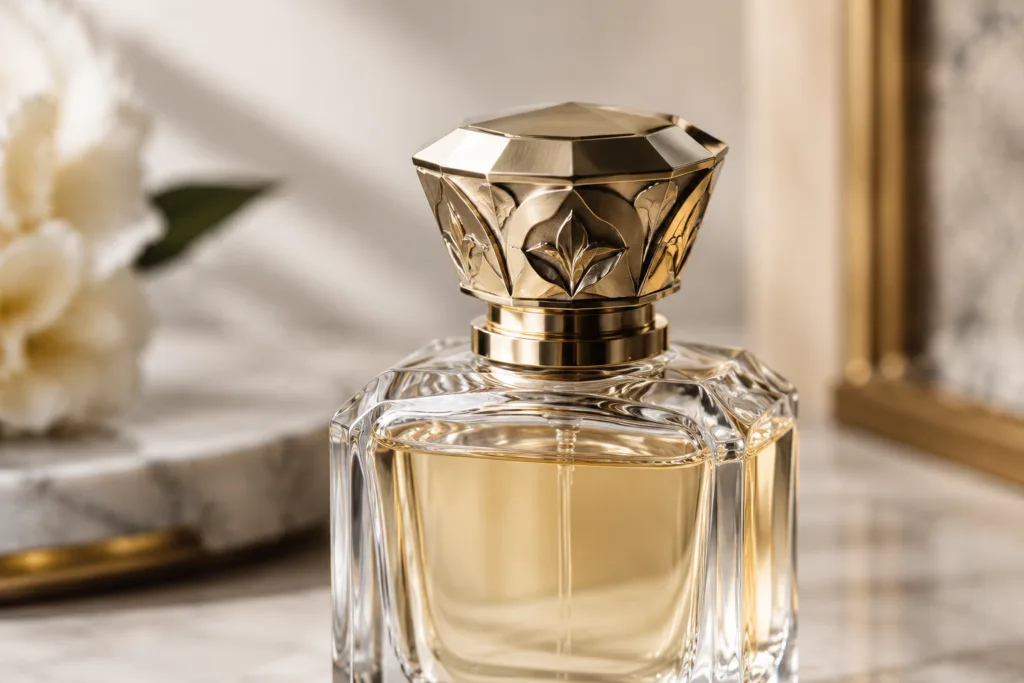
The most important answer here is that buyers must match more than neck diameter alone. A successful project depends on the relationship between neck finish, insert geometry, insertion depth, spray or collar clearance, bottle shoulder shape, and cap outer proportion.
When we review a new project, we look at both hidden and visible dimensions. Hidden dimensions control assembly. Visible dimensions control how the final package looks on shelf and in the customer’s hand.
Neck finish and insertion depth
Neck finish is one of the first technical checkpoints. Buyers should confirm the bottle neck diameter, neck height, any collar or pump interface, and the space available inside the cap. The insert must be designed to engage correctly with the intended bottle or pump structure, not just approximate it.
Insertion depth matters because it changes both appearance and retention. If the cap goes down too far, it may crowd the shoulder or interfere with the collar area. If it sits too high, the package can look unfinished and the cap may feel unstable during use.
Where projects involve custom decorative metal shells with internal inserts, we recommend checking detailed perfume bottle cap sizing and fit details before finalizing dimensions. Small differences in tolerances, insert compression, and neck geometry can change the actual fit result more than many buyers expect.
| Dimension or Feature | Why It Matters | What Buyers Should Confirm |
|---|---|---|
| Neck diameter | Controls base fit relationship | Nominal size and realistic tolerance range |
| Neck height | Affects cap seating position | How high the cap should sit visually |
| Insert inner geometry | Controls grip and removal feel | Insert material, retention strength, assembly behavior |
| Insertion depth | Changes exposure of collar and shoulder gap | Approved seating depth on real bottle samples |
| Internal clearance | Prevents rubbing or interference | Space for pump, collar, or neck variation |
| Cap bottom opening | Affects visual centering and assembly | Opening size relative to bottle top area |
A practical mistake is to approve an attractive cap shell but treat the insert as a secondary detail. In reality, the insert is often the functional core of compatibility. The metal shell gives weight, brand expression, and finish quality, but the insert largely determines whether the cap grips correctly and seats consistently.
Bottle shoulder and cap proportion
The bottle shoulder is a major visual reference point. A square, rounded, sloped, or sharply faceted shoulder changes how the cap appears even when the neck dimensions are identical. That is why proportion should be reviewed with the actual bottle, not only a dimensional sketch.
Cap diameter, height, edge profile, and overall mass should complement the bottle body. A large heavy cap can create a premium impression on a thick-walled glass bottle, but the same cap may overpower a slimmer bottle and make the package feel visually unstable. On the other hand, a cap that is too light or too narrow may make the bottle look underdeveloped.
From our zinc alloy cap experience, heavier caps often improve perceived value, but they require more discipline in balance and fit review. Weight should support premium hand feel, not create leverage that exaggerates tilt or stress if the insert engagement is not properly designed.
Key takeaway: Correct dimensions are both technical and visual. A cap must fit the neck properly and also look proportionate to the bottle shoulder, body, and overall packaging concept.
How material and structure affect compatibility
Material choice changes more than surface appearance. It influences cap weight, wall thickness possibilities, decorative detail, molding method, and how precisely the cap structure can support the insert and maintain a premium feel.
For custom fragrance packaging, zinc alloy is often chosen for decorative metal caps because it supports substantial weight, refined shapes, logo detailing, and premium finishing options such as electroplating, polishing, brushing, or painted color effects. But those advantages only matter when the cap structure is built around real bottle-fit requirements.
| Cap Type | Compatibility Advantage | Trade-Off to Watch |
|---|---|---|
| Zinc alloy decorative cap | Premium weight, strong visual presence, detailed shaping | Needs careful balance, insert design, and finish protection |
| Lightweight plastic cap | Lower weight, simpler retention demands | May not deliver luxury hand feel or metal finish depth |
| Metal shell with insert | Combines appearance and functional grip control | Requires precise coordination between shell and insert |
| Heavy custom cap with complex top shape | High brand differentiation | More sensitive to leaning, proportion, and seating depth |
At Caps Ltd, we usually encourage buyers to decide structure before debating minor finish variations. If the project has not yet confirmed bottle dimensions, pump or collar details, and insert behavior, choosing plating color first can delay the real engineering decisions that protect production stability.
What buyers should send before custom cap development
The fastest way to reduce compatibility risk is to prepare complete technical inputs from the start. Many delays happen because the cap supplier receives only a bottle photo, an approximate size, and a visual mood reference. That is not enough for reliable fit development.
For a custom project, buyers should ideally provide the following:
- Actual glass bottle samples from the final or intended bottle source
- Neck finish drawings or measured neck data
- Pump, collar, or spray component information if applicable
- Target cap weight or premium feel expectation
- Brand artwork for logo placement and decoration
- Finish references for plating, paint, gloss, matte, or brushed effect
- Expected order quantity and target launch timeline
- Packing requirements for samples and export cartons
When these inputs are available early, the cap manufacturer can define a more realistic development path, select an appropriate insert solution, and build approval checkpoints that reflect real production needs rather than assumptions.
How manufacturers test compatibility
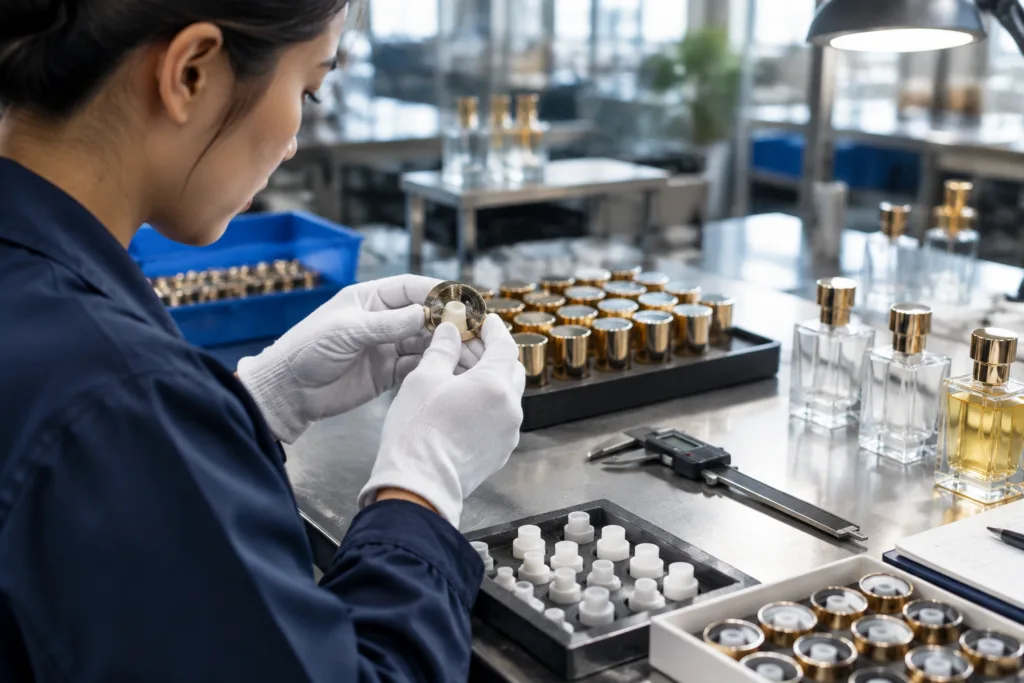
The correct way to test compatibility is through sample assembly, measurement, and repeated handling. A single attractive prototype is not enough. Buyers should expect technical confirmation of how the cap fits, how it sits, and how consistently it behaves across repeated assembly checks.
Sample assembly review
Sample review should include real assembly on the target glass bottle, not just isolated cap inspection. We recommend using sample development for cap and bottle compatibility checks so the project team can assess visual centering, seating depth, pull-off feel, rotational stability, and cap-to-bottle proportion before approving tooling changes or mass production.
A good sample review usually checks:
- Whether the cap seats to the intended visual height
- Whether the cap remains centered from multiple viewing angles
- Whether insertion and removal force feel controlled
- Whether the insert grips consistently across repeated use
- Whether the cap clears the shoulder and collar properly
- Whether the cap weight feels balanced on the bottle
- Whether logo orientation and top face presentation look correct after assembly
It is also useful to compare more than one sample if surface finish or insert hardness varies. What looks acceptable in one prototype may reveal sensitivity when a second sample is tested on additional bottle pieces.
Dimensional verification
Dimensional verification should support, not replace, assembly testing. Measurements confirm whether manufactured parts match drawings, while assembly checks confirm whether the system behaves correctly in use. Both are necessary.
Typical verification points include cap opening size, total height, cavity dimensions, insert dimensions, insert seating position, decoration alignment, and any critical interface dimension linked to bottle fit. When the cap is heavy or the bottle top area is visually exposed, small dimensional changes can become noticeable quickly.
We also recommend recording approval limits clearly. For example, the project team should know what seating depth variation is acceptable, what visual gap is allowed, and what level of removal force is considered comfortable. Vague approval language creates avoidable risk later.
| Testing Area | What Is Checked | Why It Matters in Bulk Production |
|---|---|---|
| Assembly fit | Cap seating, grip, removal feel | Reduces mismatch between sample and production use |
| Dimensional checks | Critical internal and external measurements | Protects fit repeatability across batches |
| Visual alignment | Centering, lean, shoulder clearance | Maintains premium shelf presentation |
| Finish review | Plating, paint, polishing consistency | Avoids appearance variation on assembled packs |
| Insert retention | Insert stability inside cap shell | Prevents loosening during shipping or use |
| Packing review | Protection during transport | Reduces scratches, dents, and finish damage |
Common mistakes that cause compatibility problems
The most common compatibility failures are usually process failures, not material failures. In other words, the problem often begins with missing information, incomplete validation, or unrealistic assumptions.
- Approving cap appearance before bottle-fit details are confirmed
- Using bottle drawings without testing actual bottle samples
- Changing bottle supplier or pump specification after cap approval
- Assuming all inserts with the same nominal size perform the same way
- Ignoring how cap weight affects alignment and user feel
- Skipping repeated assembly checks during sample approval
- Leaving visual gap and seating standards undefined
- Focusing on MOQs and lead time before resolving fit-critical details
A buyer can save time and cost by treating these as early review items rather than late-stage troubleshooting points. Once tooling is released and decorative finishing begins, correcting structural fit issues becomes slower and more expensive.
How finish and branding choices interact with bottle fit
Finish does not change compatibility on its own, but it changes how clearly compatibility issues are seen. Highly reflective electroplated surfaces make lean, asymmetry, and uneven seating more visible. Matte or painted finishes can soften those visual signals slightly, but they do not solve the underlying fit problem.
Logo placement also matters. If a top logo or front-facing debossed brand mark is part of the design, cap orientation and centering become more critical. A small tilt that might be ignored on an unbranded cap becomes obvious when the logo line is visibly off against the bottle face.
| Design Element | Compatibility Impact | Buyer Consideration |
|---|---|---|
| Mirror electroplating | Highlights alignment issues | Use stricter visual approval standards |
| Painted matte finish | Softens reflections but still shows seating errors | Check color consistency and edge coverage |
| Top logo engraving | Makes orientation more visible | Confirm logo direction after assembly |
| Tall cap profile | Can exaggerate leaning | Review balance on real bottle samples |
| Heavy cap weight | Improves premium feel but increases fit sensitivity | Validate insert performance carefully |
Key takeaway: Decorative finish and branding should be approved on assembled bottle samples, not on loose caps alone, because visual quality is ultimately judged in the full pack.
How to reduce production risk before mass orders
The best risk reduction method is a disciplined approval sequence. Confirm bottle data, test physical samples, define appearance limits, and document production checkpoints before bulk manufacturing begins. That sequence is more reliable than trying to solve fit issues during final packing.
We suggest a practical production-readiness checklist:
- Approved bottle sample from the intended bottle source
- Confirmed neck and collar interface data
- Approved cap sample with final insert concept
- Defined seating depth and visual gap standard
- Approved finish reference for plating or paint
- Confirmed logo artwork and placement orientation
- Bulk packing method reviewed for scratch prevention
- Inspection criteria agreed before production starts
Bulk consistency depends on process control, not sample luck. That is why buyers should ask for clear quality control checkpoints for perfume cap fit consistency in addition to appearance approvals. Dimensional checks, assembly checks, finish inspection, and packing review all support a more stable result.
How MOQ and lead time relate to compatibility decisions
MOQ and lead time are important, but they should be discussed with the fit strategy in mind. A project with a standard insert and simple shape may move faster than one requiring a new mold, complex top decoration, and multiple fit revisions for a unique bottle.
Lead time can increase when compatibility data arrives late, bottle samples change mid-project, or the cap needs repeated structural adjustment after decorative decisions have already been approved. In our experience, the most efficient projects are the ones where technical fit decisions are settled early and finish approvals follow a stable structure.
Private label fragrance teams especially benefit from this approach. When launch timing matters, a well-prepared sample stage is usually faster overall than rushing to production with unresolved fit variables.
What a strong supplier conversation should include
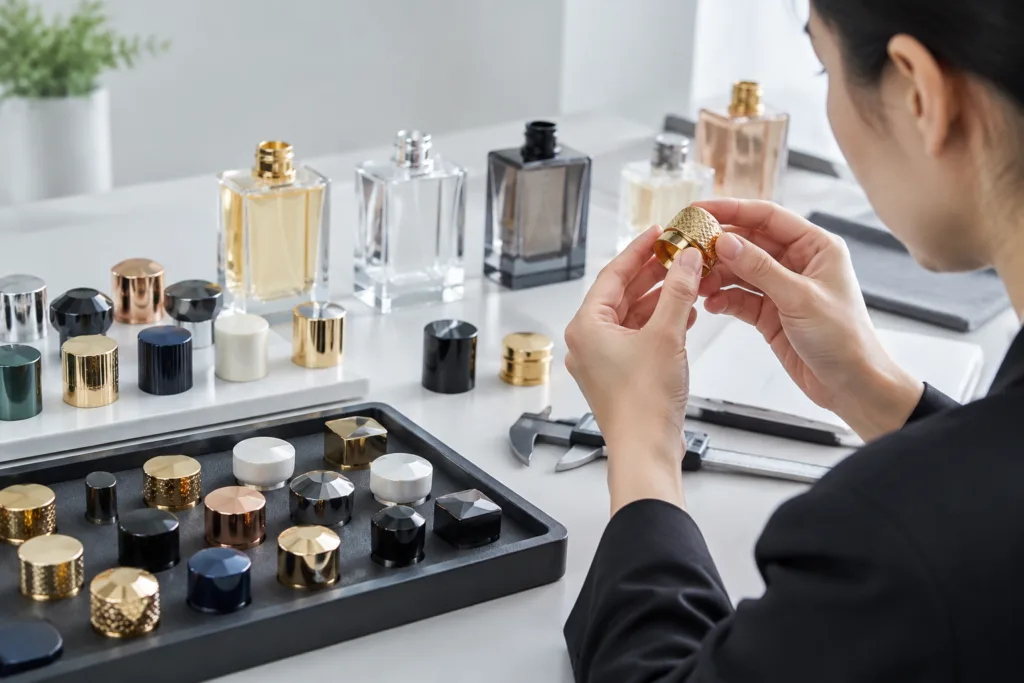
A useful supplier conversation goes beyond asking whether a cap can fit a bottle. Buyers should ask how the fit will be developed, what data is required, how the insert will be selected, what sample checks are included, and how production consistency will be monitored.
Helpful questions include:
- What bottle samples or drawings do you need before confirming fit?
- Will the insert be custom selected or adapted from an existing structure?
- How will seating depth and visual gap be approved?
- What finish limitations affect logo clarity or edge detail?
- How is cap weight balanced with retention performance?
- What dimensions are checked during production?
- How are finished caps packed to protect plating or paint?
These questions help buyers compare manufacturers based on process control, not only price or rendering quality. That is especially important for luxury fragrance packaging, where small fit issues can undermine an otherwise strong concept.
Conclusion
The right perfume bottle caps for custom fragrance packaging are the ones that match the glass bottle technically and visually. Compatibility depends on neck finish, insert structure, seating depth, shoulder proportion, cap weight, and approval discipline during sampling and production planning.
From our manufacturer perspective, the safest path is to treat cap selection as a system decision. Confirm bottle details early, test with real samples, review finish on assembled packs, and define measurable approval standards before bulk production. That approach gives fragrance brands, packaging buyers, and distributors a better chance of achieving premium presentation without avoidable fit or assembly risk.
FAQs
Why do perfume bottle caps that look correct in drawings still fail on real bottles?
Because drawings do not fully capture real assembly behavior. Glass variation, insert compression, seating depth, and shoulder clearance can change the actual fit result, so a cap that appears correct on paper still needs physical testing on real bottle samples before approval.
What is the most important dimension when choosing custom perfume bottle caps?
The most important factor is the full interface, not one single dimension. Neck diameter matters, but buyers should also confirm neck height, insert geometry, insertion depth, internal clearance, and the visual relationship between the cap and bottle shoulder to achieve a stable and attractive fit.
How many samples should be reviewed before mass production?
More than one sample is usually better for custom projects. Buyers should review enough samples to confirm assembly feel, seating consistency, finish appearance, logo presentation, and repeatability across actual bottles rather than relying on one prototype that may not reflect bulk production behavior.
Does a heavier metal cap always make fragrance packaging feel more premium?
A heavier cap often improves premium hand feel, but only when the fit is well controlled. If the cap is too heavy for the insert design or bottle proportion, it can lean, feel unstable, or exaggerate small alignment issues instead of improving the package.
What should buyers provide to a perfume cap manufacturer before development starts?
Buyers should provide real bottle samples, neck or closure drawings, pump or collar information, target finish references, logo files, quantity expectations, and timeline requirements. This allows the manufacturer to build the cap structure and sampling plan around real compatibility conditions instead of assumptions.
How can procurement teams reduce compatibility risk in bulk orders?
Procurement teams can reduce risk by approving the cap and bottle as one system, documenting fit standards clearly, confirming sample results on real bottles, and requiring defined inspection checkpoints for dimensions, assembly, finish quality, and packing protection before mass production begins.