
Buying on a perfume bottle cap wholesale basis is not just about unit price. For custom fragrance packaging, MOQ, tooling, finish complexity, bottle fit, sampling, production scheduling, and shipping readiness all affect whether a project moves smoothly or becomes delayed at the launch stage. From our manufacturing perspective, buyers get better outcomes when wholesale planning starts with the cap structure and production logic, not only with a target quantity.
If your project is still defining volume, finish direction, and timing, it helps to review perfume cap lead time and MOQ planning support early. That allows a brand or procurement team to connect order quantity with tooling scope, material choice, sample timing, decoration steps, and bulk scheduling before commercial deadlines become fixed.
What drives MOQ for custom perfume caps
The main answer is simple: MOQ rises when the cap requires more dedicated manufacturing resources. Custom tooling, special inserts, multi-step decoration, unique assembly, and strict finish matching all increase the minimum efficient production quantity.
In wholesale sourcing, MOQ is not only a sales condition. It is usually tied to process efficiency, material purchasing, plating or painting batch control, insert sourcing, and production line setup time. A buyer comparing suppliers should ask what part of the MOQ comes from tooling, what part comes from finishing, and what part comes from assembly or packing requirements.
Tooling complexity and material choice
Material choice is one of the first MOQ drivers. A lightweight plastic cap and a heavy decorative zinc alloy cap do not follow the same production logic. Metal caps often involve die casting, trimming, polishing, insert fitting, surface finishing, and more detailed appearance inspection, so order planning must reflect that complexity.
For projects with a new silhouette, custom top surface, special shoulder profile, or branded logo area, buyers should expect MOQ to be influenced by custom mold development for perfume caps. A supplier needs enough production volume to justify mold investment, sampling iterations, and stable process setup. This is especially true when the cap is not based on an existing standard structure.
Dimensional precision matters as well. Cap shells, inner inserts, bottle collars, and pump compatibility all depend on controlled measurements. In practical terms, dimensional tolerances and fit validation in component assembly affect whether a cap can be approved quickly or needs repeated correction after sampling.
| Factor | Lower MOQ Tendency | Higher MOQ Tendency |
|---|---|---|
| Cap design | Existing shape or minor modification | Fully custom silhouette and structure |
| Material | Simple plastic or standard component combination | Zinc alloy or heavy decorative metal cap |
| Tooling | Shared or adapted tooling | Dedicated new tooling set |
| Insert system | Standard insert specification | Custom insert fit for a unique bottle neck |
| Decoration | Single-process finish | Multi-step plating, painting, and logo treatment |
| Packing | Standard bulk packing | Custom tray, separator, or retail-ready packing |
Key takeaway: MOQ is usually a reflection of manufacturing efficiency and risk control, not an arbitrary number. The more custom the cap, the more important it is to align quantity expectations with tooling and process requirements.
Zinc alloy is popular in premium fragrance packaging because it gives weight, rigidity, and a stronger luxury hand feel than lighter materials. That advantage comes with trade-offs. The more solid and decorative the cap is, the more attention is needed for polishing quality, surface preparation, and dimensional repeatability before plating or painting begins.
We often advise buyers to decide early whether they want visual luxury, high cap weight, or lower project cost to take priority. Trying to optimize all three at once can create friction in MOQ discussions. When the target is a heavy metal cap with custom branding and precise fit, a higher MOQ is usually the realistic path to consistent production.
Decoration and assembly requirements
Decoration is another major MOQ driver because finishes are produced in batches. Electroplating color, painted finish, matte or glossy effect, brushed texture, and protective topcoat requirements can all affect how a supplier plans the order. A cap that looks simple in a rendering may still need multiple production stages to reach the right appearance.
Buyers should also confirm whether the project includes engraving, debossing, embossing, laser marking, pad printing, or filled logo treatment. Fine logos can be easy to approve on a sample but difficult to keep consistent at bulk scale if the surface texture, plating build-up, or paint thickness changes the contrast.
Assembly adds another layer. When the cap includes a metal shell plus a plastic insert, magnet, decorative collar, or weighted internal structure, the manufacturing plan must include insertion, bonding, torque or pull testing, and final compatibility checks. That is why it helps to define packaging and assembly requirements for custom caps before MOQ is finalized.
- Ask whether the MOQ applies to one finish or can be split across colors.
- Confirm whether logo tooling or decoration tooling is separate from the main cap mold.
- Check if assembly components must be purchased in standard batch sizes.
- Clarify whether inserts are custom-made for your bottle neck size.
- Confirm if bulk packing is standard carton packing or custom protective packing.
In our experience, wholesale buyers avoid many late-stage surprises by requesting a process-based MOQ explanation instead of only asking for the lowest possible minimum. That makes the quotation easier to compare across suppliers because it shows where cost and risk are actually coming from.
How lead time changes from sample to mass production
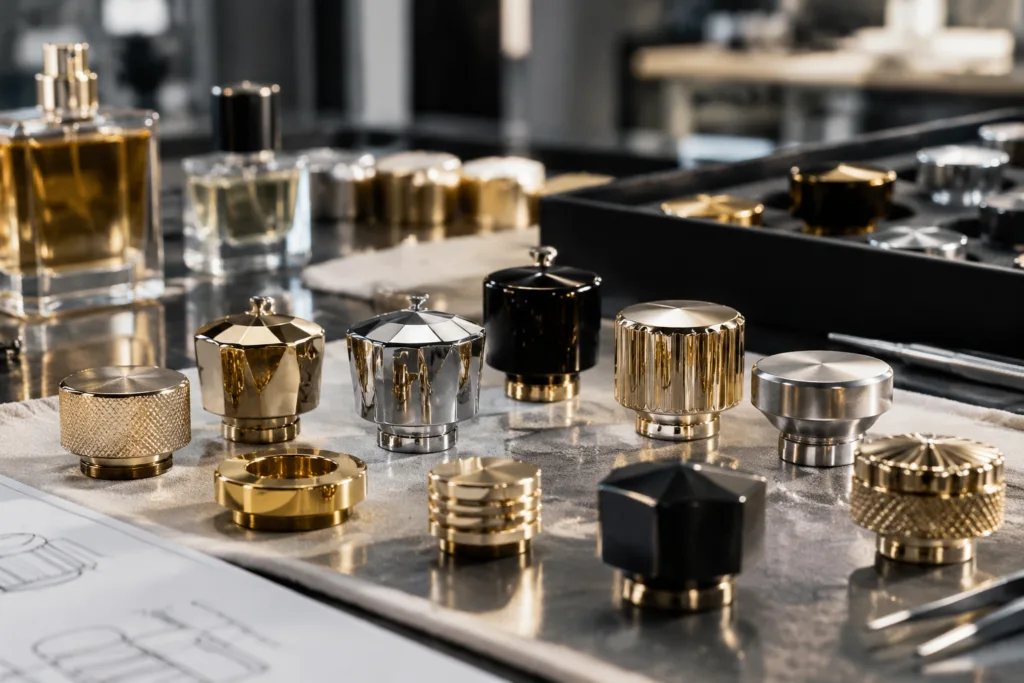
Lead time is not one single number. It changes by project stage. Prototype review, mold correction, finish approval, insert fit confirmation, mass production scheduling, and export packing each use different time windows, so buyers should ask for a staged timeline instead of a general promise.
Prototype timing
The prototype phase is where many fragrance packaging timelines are won or lost. If the buyer sends only a cap sketch without the actual bottle neck dimensions, pump specification, logo file, or finish reference, development slows down quickly. The supplier then has to pause for missing information or produce a trial sample with avoidable assumptions.
A practical timeline usually starts with drawing confirmation, then sample tooling or prototype making, then appearance and fit evaluation. If the project is fully custom, buyers should expect revisions. Even a visually correct sample may need adjustment if insertion force, cap height, logo placement, or collar clearance is not right on the real bottle.
To reduce delays, procurement teams should review the sample development steps before mass production as a formal approval path rather than a simple pre-order formality. Sample approval should check dimensions, weight, finish, logo clarity, insert retention, capping feel, and bottle alignment together.
| Sample Stage | What Buyers Should Confirm | Why It Affects Lead Time |
|---|---|---|
| Design confirmation | 3D shape, logo files, target finish, bottle drawing | Missing data causes redesign and quoting revisions |
| Prototype or trial sample | Basic shape, size, hand feel, fit direction | Revisions at this stage are normal but add time |
| Pre-production sample | Final finish, logo effect, insert fit, assembly | This stage sets the approval standard for mass production |
| Golden sample | Signed final reference sample | Reduces disputes during bulk inspection |
Key takeaway: Lead time expands when buyers treat samples as visual mockups only. The real purpose of sampling is to lock appearance, fit, and production feasibility before bulk material and production slots are committed.
One common delay happens when the bottle supplier, pump supplier, and cap supplier work on separate timelines. A cap can be technically correct in isolation and still fail at assembly because the actual bottle neck tolerance, collar height, or pump crimp position differs slightly from the early drawing. For that reason, we recommend approval based on physical assembly whenever possible, not only on CAD review.
Bulk production and export scheduling
Once a cap is approved, bulk lead time depends on material preparation, die casting or shell production, polishing, plating or painting, assembly, inspection, and packing queue. Decorative metal caps with multiple surface processes need more coordination than simple uncoated parts. Buyers should be cautious when a supplier gives one short lead time without explaining the process stages behind it.
Production schedules also depend on line loading. Peak fragrance launch periods, holiday closures, color matching adjustments, and outsourced finishing capacity can all affect delivery. That is why procurement teams should ask not only for production days, but also for booking logic: when raw material is reserved, when finish slots are scheduled, and when cartons are prepared for shipment.
Quality consistency is part of lead-time planning, not separate from it. Stable suppliers build inspection routines into production so defects are caught before packing. Buyers assessing supplier reliability can reasonably look at their use of cosmetic GMP inspection and quality-control practices when reviewing batch control, handling, documentation, and packaging-component consistency.
International shipping adds another layer. Bulk orders need protective packing that matches the cap finish, weight, and transit route. Heavy decorative caps can damage each other if separators are weak, while plated surfaces may need better anti-scratch protection. For that reason, early export packaging planning for bulk perfume cap orders should be included in the master timeline rather than treated as a last-day warehouse task.
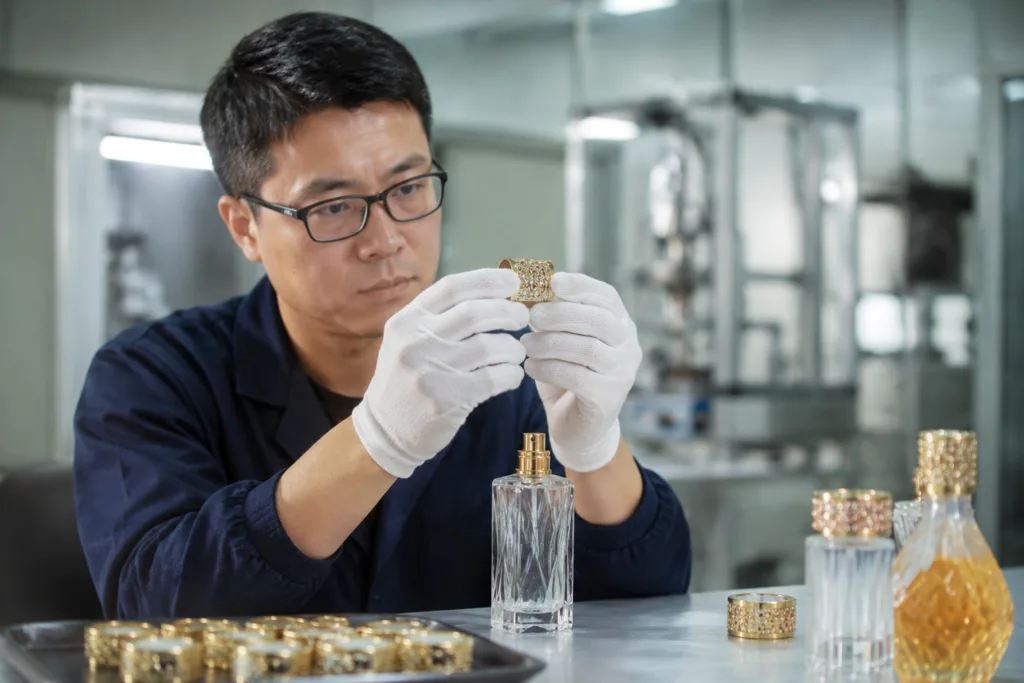
From a scheduling standpoint, buyers should build buffer time for carton approval, export document preparation, freight booking, and transit uncertainty. This matters even more for launches tied to filling schedules, retail rollout dates, or distributor delivery windows. A cap order that leaves the factory on time can still miss the launch if packing and freight coordination were underestimated.
- Ask for a timeline that separates tooling, sample, approval, production, packing, and shipment stages.
- Confirm whether plating, painting, and logo treatment are done in-house or by coordinated partner facilities.
- Check whether your order will run as one batch or split across several production dates.
- Request a realistic ship window instead of assuming ex-factory completion equals delivery readiness.
How buyers can plan orders to avoid stockouts or delays
The best way to avoid stockouts is to treat the cap as a managed packaging component, not as a last-minute accessory. Custom caps often have longer recovery time than cartons or labels because they combine tooling, finish, insert fit, and assembly compatibility. If a cap runs out unexpectedly, replenishment may require the full production cycle again.
This is where a manufacturer-informed sourcing plan matters. At Caps Ltd, we usually see stronger results when buyers define not only first-order quantity but also reorder logic, safety stock expectations, bottle supply timing, and launch sequence. That gives the cap program a realistic operating plan instead of a one-time purchase mindset.
Forecasting and re-order strategy
Forecasting does not have to be perfect to be useful. Buyers should at least estimate launch volume, first replenishment timing, and how many SKUs may share the same cap shell with different finishes or logos. Shared structures can improve purchasing efficiency, but only if the finish and assembly plan are consistent enough to support batch production.
A simple reorder strategy usually includes three decisions: reorder trigger point, safety stock level, and forecast review frequency. These decisions should reflect not only sales volume but also cap lead time, finish complexity, and transit risk. Heavy decorative caps with custom inserts generally deserve more safety stock than standard caps sourced from existing molds.
| Planning Item | What to Decide Early | Risk If Ignored |
|---|---|---|
| Launch quantity | Initial cap demand plus approval and scrap allowance | Shortage before filling starts |
| Safety stock | Buffer based on lead time and sales variability | Stockout during replenishment cycle |
| Reorder trigger | Inventory level that starts the next PO | Order placed too late for custom production |
| SKU strategy | Shared cap platform or separate custom caps | Unnecessary tooling and fragmented MOQ |
| Finish approval standard | Signed sample and acceptance criteria | Disputes on color or logo in bulk production |
Wholesale buyers should also ask whether the supplier can reserve inserts, finish materials, or packaging materials for repeat orders. In some projects, the cap shell may be stable while finish color changes seasonally. In others, the shell and insert remain constant but the logo treatment changes for limited editions. Those differences affect how flexible the reorder plan can be.
We recommend keeping one approved reference sample and one approved packing reference at the procurement level, not only with the supplier. This helps new team members, regional offices, and contract filling partners stay aligned when repeat orders are placed months after the first production run.
Packaging launch coordination
Custom cap planning should be coordinated with bottle production, pump sourcing, labeling, filling, and outer box timing. A fragrance launch can be delayed by a cap even when every other packaging component is ready. That is why cross-supplier communication matters more than isolated price comparison.
One practical method is to build the cap timeline backward from the filling date. Start with the date when assembled bottles must be available, then subtract inbound logistics time, final cap delivery, packing time, inspection, production, sample approval, and tooling if needed. This backward scheduling approach gives a more realistic purchase decision window.
- Share the real launch date and filling date with the cap supplier early.
- Provide bottle samples or confirmed neck drawings before final tooling release.
- Align cap approval with the actual pump and bottle combination.
- Decide whether caps ship in bulk cartons, trays, or retail-ready configurations.
- Build a buffer for freight delays, customs handling, and internal warehouse receiving.
Packaging distributors and private label buyers often manage several projects at once, so internal approval speed becomes part of lead-time control. If design, procurement, and quality teams review samples on different schedules, a project can lose weeks even when the factory is ready. Clear internal signoff rules are often as important as supplier capacity.
Common mistakes that make wholesale cap projects harder than they need to be
The most common mistake is assuming that all wholesale cap orders follow the same MOQ and lead-time pattern. A standard cap from existing tooling is very different from a heavy zinc alloy cap with custom electroplating, logo treatment, and a bottle-specific insert. Buyers should compare projects by process complexity, not just by quantity.
Another mistake is approving a finish from digital artwork only. Metal surfaces react differently under polishing, plating thickness, paint build, and lighting conditions. Sample approval should always be based on the real physical cap whenever appearance is important to the brand presentation.
We also see avoidable delays when bottle fit is confirmed too late. If the pump, collar, bottle neck, and insert are not aligned early, the supplier may need to change insert dimensions or shell clearance after decorative work is already planned. That creates added cost and pushes out delivery.
| Mistake | Likely Consequence | Better Approach |
|---|---|---|
| Requesting quote without bottle data | Inaccurate fit assumptions and sample delays | Send bottle drawing or physical sample first |
| Choosing finish before structure is stable | Rework after sample correction | Lock shape and fit before final finish approval |
| Using only visual sample criteria | Assembly problems in bulk run | Approve fit, weight, logo, and handling together |
| Placing order too close to launch | Freight pressure and stockout risk | Build sourcing plan backward from launch date |
| No signed reference standard | Bulk quality disputes | Keep approved sample and inspection criteria on file |
Key takeaway: The safest perfume bottle cap wholesale plan is the one that connects design, fit, finish, quantity, and launch timing from the start. Problems usually appear when those decisions are made in isolation.
What buyers should prepare before asking for a wholesale quotation
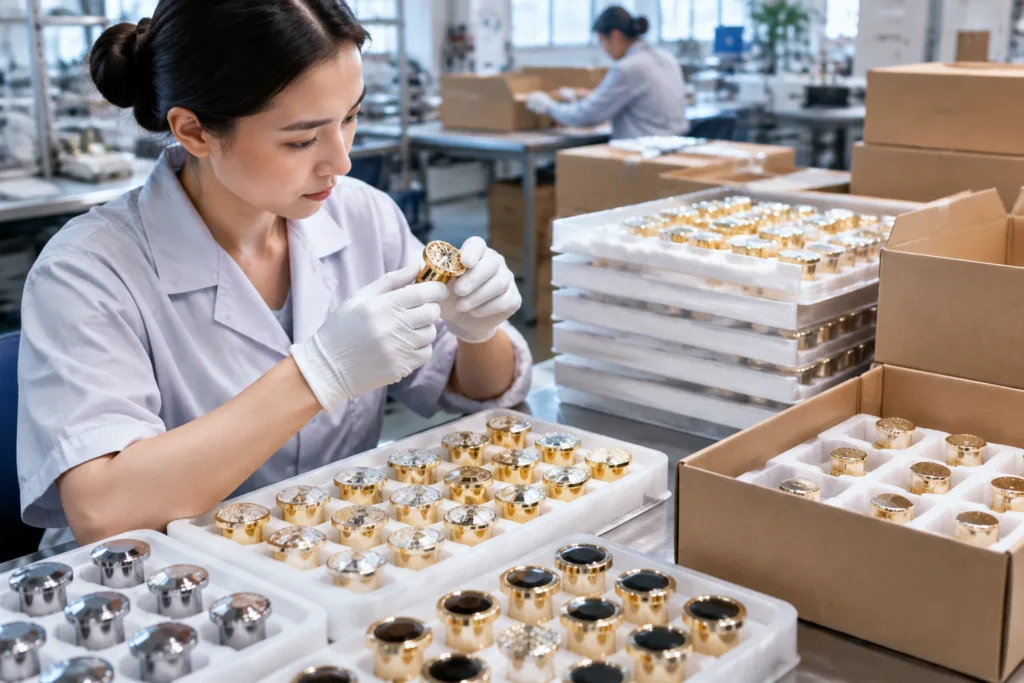
A strong quotation request saves time for both buyer and manufacturer. It also makes supplier comparisons more meaningful because each factory is pricing the same technical scope. When information is incomplete, quotations may look competitive but still hide later cost or timing changes.
- Target quantity for launch and repeat order expectation
- Bottle drawing or physical bottle sample
- Neck size, pump information, and collar details if available
- Preferred cap material and target weight range
- Finish reference such as bright plating, matte plating, painted effect, or brushed look
- Logo artwork and preferred branding method
- Packing requirement for bulk shipment or assembly line use
- Target launch date and required delivery location
For private label fragrance projects, it is also useful to state whether the design needs to fit multiple bottle sizes in one collection. That can change the insert strategy and affect whether the same shell can be reused across SKUs. Small structural decisions early in development can improve cost-performance balance later.
Conclusion
Perfume bottle cap wholesale decisions work best when buyers understand what is actually driving MOQ and lead time. Tooling complexity, material choice, decoration, insert fit, assembly method, approval discipline, and export planning all shape the real project timeline. When those factors are discussed early, wholesale sourcing becomes easier to compare and far more predictable.
From our manufacturing perspective, the most effective projects are the ones with clear drawings, realistic quantity planning, physical fit validation, signed finish standards, and enough scheduling buffer for production and shipment. Whether the cap is a simple standard style or a custom decorative metal closure, disciplined planning reduces launch risk and supports more stable repeat orders.
FAQs
What is a typical MOQ for custom perfume bottle caps?
A typical MOQ depends on the cap structure and production process, not just on supplier policy. Existing designs with standard inserts may allow lower minimums, while fully custom zinc alloy caps with special tooling, plating, painting, or logo treatment usually require higher quantities to make production efficient and consistent.
Why does a custom metal perfume cap usually need more lead time than a standard cap?
A custom metal perfume cap usually needs more lead time because it involves more stages, including tooling, die casting, polishing, finishing, insert fitting, assembly, and inspection. If the project also needs bottle-fit adjustment or multiple sample rounds, the timeline becomes longer than a standard cap made from existing components.
What should buyers approve before mass production starts?
Buyers should approve the final sample for shape, dimensions, weight, bottle fit, insert retention, surface finish, logo effect, and packing method before mass production starts. A signed reference sample and clear acceptance criteria help reduce disputes and make bulk inspection more consistent.
Can one wholesale order be split across several colors or finishes?
One wholesale order can sometimes be split across several colors or finishes, but it depends on the supplier’s finishing process and minimum batch requirements. Buyers should confirm this early because plating and painting often run in production batches, and splitting the order too much can affect MOQ, pricing, and lead time.
How can buyers reduce the risk of cap-to-bottle fit problems?
Buyers can reduce the risk of cap-to-bottle fit problems by providing the real bottle sample or accurate neck drawings as early as possible. Fit should be checked on the actual bottle and pump assembly, because small dimensional differences in the bottle neck, collar, or insert can change how the cap sits and performs.
When should a brand place a repeat order for custom perfume caps?
A brand should place a repeat order before inventory reaches the point where lead time, packing, and transit could interrupt filling or shipment plans. The right reorder point depends on sales speed, safety stock policy, finish complexity, and how long the supplier needs for production and export preparation.