
For distributors, traders, and private label buyers, perfume bottle cap wholesale is not just a price comparison exercise. The real decision is whether a manufacturer can support repeat orders, hold finish consistency, manage bottle fit accurately, and keep export shipments stable across multiple projects. A cap that looks acceptable in one sample round can still create sourcing risk later if dimensions drift, plating changes tone, inserts loosen, or documents are incomplete.
If your business needs perfume cap sourcing support for packaging distributors, it helps to work with a manufacturer that can review bottle compatibility, advise on cap structure and finish feasibility, organize sampling clearly, and prepare production with repeat-order control in mind. From our perspective as a decorative metal cap manufacturer, distributor-focused support usually starts with practical details: bottle samples, target weight, logo method, finish references, quantity planning, and the inspection points that matter before bulk shipment.
What wholesale buyers should prioritize
The first priority is simple: choose a manufacturer that can supply reliably, not just quote attractively. For wholesale buyers, stable supply means the supplier can repeat the same cap structure, finish effect, assembly fit, and packing method over time without restarting the project from zero on every order.
In our production experience, wholesale risk usually appears in three places. The first is dimension control, especially around insert fit and bottle neck compatibility. The second is finish variation, including plating color drift, paint gloss difference, or polishing inconsistency. The third is shipment execution, where good products can still arrive with scratches, loose inner packing, or mixed-lot confusion.
Key takeaway: A good wholesale perfume cap partner should be evaluated on repeatability, measurable QC discipline, and export execution, not only on sample appearance or unit price.
Capacity and repeat order support
Capacity matters, but buyers should define it correctly. It is not only about how many caps a factory can produce in one month. It is about whether the manufacturer can maintain the same approved standard when your order volume grows, when a distributor needs staggered deliveries, or when several SKUs share related finishes and inserts.
Ask how repeat orders are controlled after the first approval. A reliable manufacturer should be able to refer back to the approved drawing, finishing standard, logo artwork, insert specification, and packing requirement. If there is no clear order history system, repeat orders become dependent on memory instead of process.
When we review distributor programs at Caps Ltd, we usually separate one-off development work from repeat-order management. That distinction matters because wholesale supply is often less about making the first sample and more about preserving the same quality window for future production. A manufacturer should be able to explain how tooling records, color references, insert sourcing, and inspection criteria are carried forward to the next batch.
Buyers should also confirm whether the supplier can support mixed project types, such as:
- standard repeat caps for ongoing fragrance lines
- custom decorative metal caps for premium launches
- private label perfume cap programs with shorter development windows
- regional distributor orders with different packing marks or shipment schedules
If the manufacturer cannot handle both standardization and customization in an organized way, wholesale expansion becomes difficult.
Packaging consistency and logistics
Packaging consistency is often underestimated in perfume bottle cap wholesale projects. Decorative metal caps can be scratched, rubbed, dented, or contaminated during storage and transit if inner protection is weak. This matters even more for electroplated, polished, or high-gloss painted surfaces because minor abrasion becomes visible immediately at arrival.
Ask for the supplier’s packing method, carton logic, inner tray or bag protection, lot identification, and pallet approach for export shipments. A factory that understands distributor needs should be able to explain how products are separated, counted, labeled, and protected for warehouse handling and onward delivery.
For decorative components shipped internationally, buyers should also care about shipment validation, not only packaging materials. Guidance around transit-tested export packaging protection for metal components is useful because transport vibration, compression, and handling shock can affect cosmetic parts even when production quality is acceptable.
This is why many buyers review export packaging support for wholesale fragrance cap shipments before confirming a large order. The packaging method should match finish sensitivity, cap weight, carton stacking conditions, and final shipping route.
| Wholesale priority | What to confirm | Why it matters |
|---|---|---|
| Repeat-order consistency | approved sample retention, finish standard, insert spec, drawing control | reduces variation between batches |
| Capacity planning | batch scheduling, MOQ logic, reorder support | helps distributors serve ongoing demand |
| Packing protection | inner protection, carton design, lot labels | prevents transit damage and sorting errors |
| Shipment readiness | export documents, carton marks, pallet logic | supports international distribution programs |
Key questions to ask a cap manufacturer
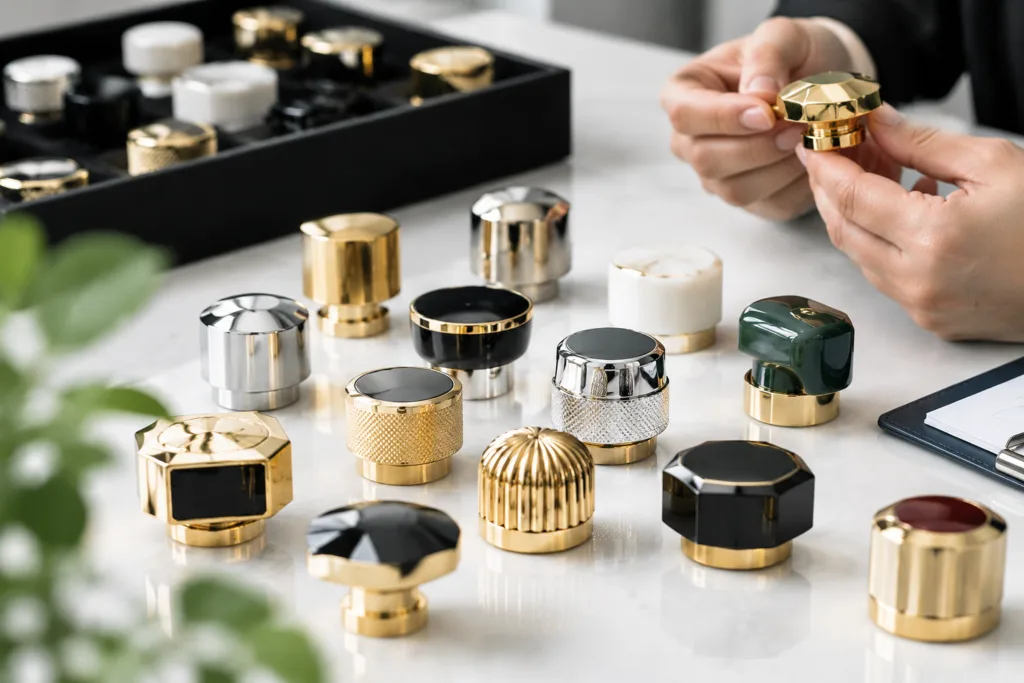
The best supplier conversations are specific. Instead of asking whether a manufacturer can make custom perfume caps, ask how the project will be controlled from drawing review to sample approval to final inspection. Detailed questions reveal process maturity quickly.
MOQ, lead time, and sample policy
MOQ should never be evaluated as a number alone. Buyers need to understand what drives it: custom mold cost, zinc alloy die casting setup, finishing complexity, logo treatment, insert sourcing, and packing structure. For a distributor, low MOQ can look attractive at the start, but if the production method is unstable or not cost-aligned, future orders can become difficult.
Lead time should also be broken into stages. Ask for mold development time, pre-production sample time, bulk production time, and packing time separately. This gives a clearer picture of what can be repeated and what depends on first-order development.
A useful discussion usually includes:
- whether MOQ changes for existing molds versus new molds
- whether finish complexity changes the minimum quantity
- how long insert development and bottle fit testing will take
- how many sample rounds are realistic before bulk production
- what approvals are required before the supplier books production
Buyers comparing factories often benefit from reviewing lead time and MOQ planning for bulk perfume cap orders early, because delayed decisions on artwork, bottle samples, and finish references usually extend the timeline more than production itself.
Key takeaway: The most reliable lead time is the one tied to confirmed drawings, approved finish references, and defined fit criteria, not the shortest estimate on a quotation sheet.
Customization and QC capabilities
Customization is where many wholesale programs succeed or fail. A supplier may show attractive sample photos, but buyers should confirm whether the manufacturer can actually control shape, weight, logo clarity, finish repeatability, and fit across production volume.
For decorative metal caps, common customization points include zinc alloy outer shape, insert structure, electroplated or painted finish, top disc design, embossing or debossing, engraving depth, and color contrast between the logo and body finish. Each of these affects both appearance and manufacturability.
QC capability is equally important. It should cover incoming material checks, in-process dimensional checks, finish inspection, assembly testing, and final packing verification. The supplier should be able to explain not just that it inspects products, but what is inspected, how often, and against which approved standard.
Distributors sourcing premium or mid-to-high decorative caps should ask for quality control checkpoints for repeat perfume cap production because cosmetic acceptance is only one part of the decision. Wholesale buyers also need confidence that fit, insert holding force, logo definition, and finish durability are reviewed consistently.
| Question to ask | Strong manufacturer answer | Warning sign |
|---|---|---|
| How is MOQ set? | Explains mold, finish, insert, and packing factors | Gives one number without context |
| How is lead time built? | Separates sampling, approval, and mass production stages | Provides one vague total time only |
| How are custom finishes controlled? | Uses approved standard samples and process records | Relies on visual judgment only |
| How is fit checked? | Uses bottle samples, dimensions, inserts, and assembly testing | Assumes standard neck size without validation |
| What happens before shipment? | Has final inspection and packing verification steps | Focuses only on production completion |
How to assess supplier reliability for distribution
Reliability for distribution means the supplier can support your downstream obligations. If you supply fragrance brands, packaging buyers, or regional wholesalers, your reputation depends on the manufacturer’s ability to deliver stable quality with usable documentation and predictable communication.
Communication and documentation
Good communication is operational, not just responsive. A dependable factory should ask for bottle drawings or physical samples, logo files, finish references, quantity expectations, target launch timing, and packing requirements. These questions are a positive sign because they show the supplier is trying to define risk before production starts.
Documentation is where serious manufacturers stand apart from traders who only coordinate quotations. Buyers should ask whether the supplier maintains approved drawings, sample records, inspection standards, lot records, and corrective action history. In practice, these documented files are what protect repeat-order consistency when teams change or when a project restarts months later.
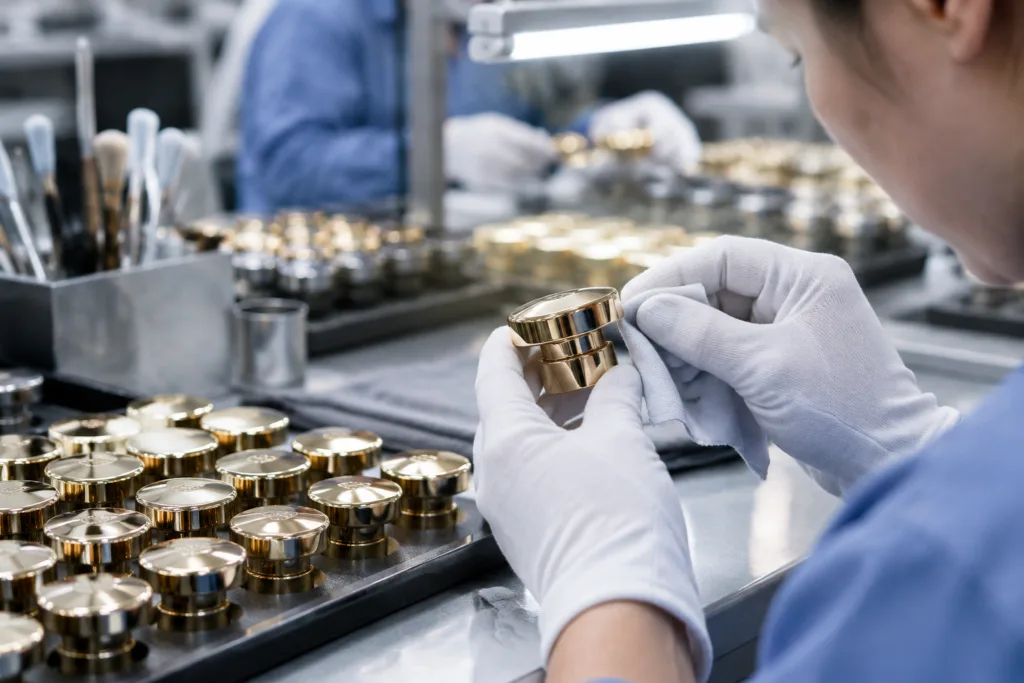
That is one reason we encourage buyers to review documented quality control and traceability practices as part of supplier evaluation thinking. Even though fragrance caps are packaging components rather than filled cosmetics, the discipline around storage, traceability, inspection, and complaint handling is highly relevant for reducing wholesale risk.
From our manufacturing perspective, the most useful documents in a perfume cap project usually include:
- approved cap drawing with key dimensions
- bottle or pump mating-part information
- finish reference sample or color benchmark
- logo artwork file and placement standard
- sample approval notes with accepted and rejected points
- packing specification and carton labeling requirement
Clear documentation helps both sides. The buyer knows what was approved, and the factory has a measurable production target instead of subjective expectations.
Export readiness
Export readiness should be checked before the order is placed, not after production finishes. Many manufacturers can produce a decorative cap, but fewer can prepare cartons, labels, count control, packing protection, and shipping documents in a way that supports importers and distributors smoothly.
Ask how the factory identifies lots, how mixed SKUs are separated, what outer carton markings are available, and how quantities are controlled during final packing. For wholesale buyers, missing labels or inconsistent carton counts can create warehouse delays even when the product itself is acceptable.
It is also important to confirm whether the supplier understands finish-specific packing needs. Heavy zinc alloy caps with polished or plated surfaces need different protection from lightweight painted caps. Caps with tall decorative profiles or protruding logos may need more stable internal arrangement to avoid impact marks.
For projects involving multiple bottle formats, buyers should also review bottle fit engineering for distributor-ready cap compatibility. Fit issues are one of the most expensive wholesale problems because they often appear only after bottle assembly or market distribution, when correction is slower and more costly.
Why dimensional control matters more than many wholesale buyers expect
Dimensional accuracy is one of the most practical indicators of manufacturer maturity. Perfume caps are decorative, but they are also mating parts. If internal dimensions, insert tolerances, neck interface assumptions, or assembly positions are not controlled, the result can be wobble, loose pull force, poor seating, or visible misalignment.
This is especially important when a distributor needs repeat orders over time or wants one cap family to work across several bottle programs. Dimensional control should be based on approved drawings and measurable checks rather than general statements about experience. Technical guidance on dimensional tolerances and fit verification for cap components reinforces why measurable inspection criteria matter in manufactured parts that must assemble consistently.
In daily production terms, buyers should confirm that the supplier checks dimensions that actually affect use, including inner cavity, insert retention area, overall height, collar seating, and logo orientation when assembly direction matters. Appearance alone cannot confirm fit reliability.
Key takeaway: If your wholesale project depends on bottle compatibility, dimensional checks should be part of the approval process from the sample stage, not only after mass production begins.
How finish choices affect wholesale risk and repeatability
For distributors, finish selection is not only a design decision. It is a sourcing decision that affects rejection risk, color tolerance, handling sensitivity, and replacement complexity. Two finishes may look equally premium in a sample room but behave differently in mass production and transit.
When electroplated caps make sense
Electroplated perfume caps are often selected for mirror-like metallic appearance, luxury positioning, and strong visual contrast with glass bottles. They can create a solid premium feel when paired with zinc alloy construction, but the final result depends heavily on surface preparation. Poor polishing under the plating layer will usually remain visible after finishing.
Electroplated finishes are a good fit when the project prioritizes reflective appearance, metal identity, and consistent premium presentation across a fragrance line. Buyers should still check color reference, micro-scratch sensitivity, and packing protection because reflective surfaces reveal small defects more quickly.
When painted caps are the better choice
Painted perfume caps are often more flexible for exact color targets, softer visual styles, and matte or brand-specific presentation. They can also work well when a buyer needs tighter alignment with bottle coating or carton color. However, painted caps require clear standards for gloss, opacity, edge coverage, and scratch acceptance.
From our production view, painted and plated caps should not be approved in the same way. Plated parts are often judged by reflectivity, plating tone, and polishing quality. Painted parts need more emphasis on color consistency, coating uniformity, and edge performance.
| Finish type | Strengths | Main control points | Wholesale concern |
|---|---|---|---|
| Electroplated | premium metallic look, strong luxury perception | polishing quality, plating tone, surface cleanliness | scratch visibility during packing and transit |
| Painted | flexible color matching, matte or soft-touch look | color consistency, gloss, coating coverage | batch-to-batch color shift if standards are unclear |
| Brushed or matte metal effect | hides minor marks better, refined appearance | texture consistency, directional finish control | variation if pre-finish preparation is not stable |
Common mistakes distributors should avoid when evaluating wholesale suppliers
Several sourcing mistakes appear repeatedly in perfume cap projects. Most of them are preventable if buyers ask the right questions before approving samples or placing production orders.
- Approving a cap only by appearance without confirming bottle fit and insert structure.
- Comparing quotations without understanding whether mold, finish, and packing standards are equivalent.
- Assuming a sample finish can be repeated in bulk without a retained approval standard.
- Sending logo artwork late, which delays tooling or creates avoidable sample revisions.
- Ignoring shipping protection until after production, especially for polished and plated caps.
- Accepting vague lead times that do not separate development from mass production.
These issues matter because wholesale supply chains amplify small mistakes. A minor variation in pull force or finish tone may be manageable for one boutique launch, but it becomes a broader commercial problem when a distributor serves several customers from repeated stock.
A practical checklist for choosing a perfume bottle cap wholesale partner

Before selecting a manufacturer, buyers can use a simple decision checklist. The goal is not to find a perfect supplier on paper, but to identify whether the factory can support your actual operating model.
- Can the manufacturer explain how repeat orders are controlled after first approval?
- Can it review bottle samples and identify fit risks early?
- Does it distinguish between sample quality and bulk production control?
- Are finish standards measurable and retained for future batches?
- Can it explain MOQ and lead time drivers clearly?
- Does it have final inspection and export packing logic for decorative parts?
- Are drawings, artwork, and sample records managed in an organized way?
- Can it support both standard reorders and custom development when needed?
If the answer to several of these questions is unclear, the buyer should slow down before committing to a wholesale program. Early clarity is much cheaper than late correction.
Conclusion
The right perfume bottle cap wholesale partner is not simply the supplier with the fastest quotation or the widest finish list. For distributors and traders, the stronger choice is usually the manufacturer that can show repeat-order discipline, bottle fit control, realistic lead time planning, finish consistency, and export readiness in a structured way.
From our experience, wholesale perfume cap projects run more smoothly when buyers share bottle samples, artwork, finish references, quantity plans, and target markets early. That gives the manufacturer a real basis for mold development, fit validation, inspection planning, and shipment preparation. When these details are aligned at the start, sourcing risk goes down and repeat supply becomes much easier to manage.
FAQs
What is the most important factor when choosing a perfume bottle cap wholesale manufacturer?
The most important factor is repeatability. A manufacturer should be able to reproduce the same approved cap structure, finish, fit, and packing standard across future orders, because wholesale success depends more on consistency over time than on a single attractive sample.
How should distributors evaluate MOQ and lead time for custom perfume caps?
Distributors should evaluate MOQ and lead time by asking what drives them, including mold development, finish complexity, insert sourcing, and packing requirements. A useful quotation separates sample timing from bulk production timing so the buyer can see which parts of the schedule are fixed and which depend on approvals.
Why does bottle fit cause so many wholesale problems?
Bottle fit causes problems because a perfume cap is a decorative part that also has to assemble correctly with the bottle neck, pump, collar, or insert system. If dimensions and mating-part assumptions are not checked early, the cap may look good as a sample but fail in assembly or repeated use.
Which finish is easier to manage in bulk, electroplating or painting?
Neither is automatically easier, because each has different control points. Electroplating depends heavily on polishing quality and surface cleanliness, while painted finishes depend more on color consistency, gloss control, and coating coverage, so the better choice depends on the project’s visual target and quality tolerance.
What documents should a reliable perfume cap manufacturer provide or maintain?
A reliable manufacturer should maintain approved drawings, sample records, finish references, logo files, inspection criteria, and packing specifications. These records help protect repeat-order consistency and make it easier to resolve questions about quality, fit, and shipment execution later.
How can buyers reduce risk before placing a bulk perfume cap order?
Buyers can reduce risk by sending bottle samples, confirming key dimensions, approving a retained finish standard, clarifying MOQ and lead time assumptions, and agreeing on inspection and packing requirements before production begins. This creates a measurable approval basis instead of relying on general expectations.