
Choosing between direct Perfume bottle cap manufacturers and marketplace sellers is usually not just a price decision. For fragrance brands, private label buyers, packaging distributors, and procurement teams, the real question is which sourcing channel gives better control over cap quality, bottle fit, finish consistency, lead time reliability, and problem solving when a project becomes more complex than a catalog order.
If you are comparing sourcing paths, it helps to review perfume bottle cap manufacturing options in the context of your actual packaging goals. Projects that involve custom zinc alloy caps, branded logo treatment, bottle neck fit validation, or luxury finish approval usually need more than a simple trading transaction. At Caps Ltd, we support these stages through cap structure review, mold planning, finish selection, sampling, QC preparation, and export coordination so buyers can reduce risk before bulk production begins.
Manufacturer sourcing vs marketplace sourcing
The practical difference is simple: a direct manufacturer usually gives you process visibility and technical control, while a marketplace seller often gives you speed of access and supplier variety. That difference matters most when the cap is custom, decorative, heavy, finish-sensitive, or structurally linked to a specific bottle neck and insert design.
Marketplace sourcing can work for standard caps with simple requirements. But once the project includes custom weight targets, electroplating, painted finishes, logo engraving, insert fit, or private label branding, buyers usually need a supplier that can explain how the cap is actually made, checked, packed, and shipped.
Key takeaway: The more customized and quality-sensitive the cap project is, the more valuable direct factory access becomes.
Customization depth and tooling control
Direct factories generally perform better when your project requires engineering changes. A custom metal cap is not only a shape; it is a combination of alloy structure, wall thickness, internal insert design, logo placement, polishing level, finish build, and final fit with the bottle and pump or collar system.
When buyers work with a manufacturer, they can discuss drawing revisions, logo depth, balance, cap weight, finish sequence, and assembly tolerances with the team actually managing production. That makes decision making faster and usually more accurate than sending questions through a marketplace intermediary who may not control the tooling or even fully understand the process limits.
For custom projects, we recommend asking early about mold ownership, engineering sign-off, dimensional tolerances, and revision handling. Buyers who need advanced customization should also ask whether the supplier offers OEM perfume cap development support, because OEM capability usually signals stronger control over design translation, artwork handling, and production planning.
Tooling control is especially important for zinc alloy caps. The quality of die casting affects sharp edges, wall consistency, logo clarity, polishing workload, and downstream finishing results. Industry references such as zinc alloy die casting standards and tooling control are useful because they show why process capability, tolerances, and QA discipline matter when evaluating decorative metal cap suppliers.
| Factor | Direct Manufacturer | Marketplace Seller |
|---|---|---|
| Custom mold changes | Usually faster and more technical | Often depends on upstream factory approval |
| Tooling visibility | Higher, especially with drawings and samples | Can be limited or unclear |
| Material discussion | Can compare zinc alloy, inserts, and finish impact | May focus more on quoted appearance |
| Engineering communication | Direct with production-oriented team | Filtered through trader or platform agent |
| Change control | Better for ongoing revisions | Can become slow or inconsistent |
Quality consistency and MOQ considerations
MOQ is not only a commercial threshold. It is often linked to tooling setup, plating line planning, paint color matching, insert sourcing, assembly labor, and inspection efficiency. Direct manufacturers are more likely to explain why one cap design has a different MOQ than another, because they see the full production cost structure.
Marketplace sellers sometimes quote attractive MOQs without clarifying how finish variation, logo treatment, or insert specification will affect batch stability. This can create problems later when the first approved sample looks good but the bulk order shows color shift, inconsistent polishing, loose fit, or logo variation.
From our manufacturing perspective, MOQ should be discussed together with these points:
- Whether the cap uses an existing mold or a new mold
- Whether the finish is electroplated, painted, brushed, polished, or mixed
- Whether inserts are standard or customized for the bottle neck
- Whether the logo treatment requires additional process steps
- Whether the order includes multiple colors or SKUs
- Whether export packaging needs extra protection for decorative surfaces
Buyers should also compare MOQ flexibility against production reliability. A low MOQ is not automatically better if it results in unstable finishing, rushed assembly, or weak quality sorting.
What buyers gain by working with a direct factory

Working with a direct factory usually improves technical clarity, accountability, and escalation speed. If a cap needs to be heavier, fit tighter, polish cleaner, or match a branding standard more closely, the buyer can often reach the team that can make the adjustment instead of only the team that placed the order.
Better OEM/ODM support
OEM and ODM support matters when a buyer does not yet have a fully production-ready cap specification. Some fragrance brands have a strong visual concept but no insert specification. Others have bottle artwork but need help translating it into a cap with suitable weight, hand feel, and decoration. A direct factory can usually guide these decisions more effectively.
At this stage, the right partner should ask for bottle samples, neck dimensions, target appearance, logo files, finish references, quantity expectations, and packaging requirements. Those inputs help prevent common failures such as oversized cap cavities, weak grip, off-center logo placement, or unrealistic finish expectations for the chosen budget.
Custom projects are more reliable when the supplier can manage mold development for custom perfume caps with engineering review before sampling. This is especially important for heavy metal caps, where a small internal mismatch can create poor balance, assembly friction, or instability during use.
A good factory conversation should cover more than outer appearance. Buyers should ask about:
- Cap material and approximate weight range
- Inner structure and insert type
- Bottle neck and collar compatibility
- Logo process options such as engraving, debossing, embossing, or printing
- Finish route such as polishing plus electroplating or texture plus baked paint
- Scratch protection and carton packing method
- Sampling timeline and revision limits
This is where working with Caps Ltd or another genuine factory partner can be more useful than browsing marketplace listings. The conversation becomes about manufacturability, not only product photos.
More reliable lead times and export coordination
Lead time reliability depends on process sequencing. A decorative cap may move through die casting, trimming, polishing, logo treatment, plating or painting, insert assembly, inspection, and export packing. If one stage slips or one specification changes late, the final delivery date can move quickly.
Direct factories are generally better at explaining critical path items because they see actual production scheduling. Marketplace sellers may provide a quoted lead time without enough visibility into polishing capacity, plating queue, insert arrival, or rework allowance.
Export coordination is another major difference. For buyers importing packaging components, it helps when the supplier understands carton marking, packing lists, invoice accuracy, SKU separation, and shipment document consistency. The International Trade Administration outlines export documentation required for international packaging shipments, and this is a useful reminder that freight success depends on paperwork accuracy as much as product readiness.
Key takeaway: A capable export-ready manufacturer reduces risk not only in production, but also in shipment preparation, carton organization, and document control.
| Procurement issue | Direct factory advantage | Typical marketplace risk |
|---|---|---|
| Lead time explanation | Can explain each production stage | May give only an overall estimate |
| Revision handling | Faster internal coordination | Extra communication layers |
| Shipment packing logic | Closer control of carton arrangement | May rely on third-party packing assumptions |
| Export documents | Usually more systematic for repeat shipments | Higher risk of incomplete detail if unmanaged |
| Delay escalation | Can identify process bottleneck directly | Buyer may receive late or partial updates |
How to evaluate a perfume cap supplier
The fastest way to evaluate a supplier is to test their ability to answer specific production questions. A strong supplier does not only say yes; they explain how they will confirm fit, how they will build the sample, how they will protect the finish, and how they will inspect the bulk order.
When comparing suppliers, buyers should request a clear quotation and a clear process explanation. If the price looks similar but one supplier provides more technical detail, clearer approval checkpoints, and better risk warnings, that supplier may be the safer option even before samples are made.
Sampling process and communication
Sampling is where many sourcing decisions become obvious. Good suppliers treat sampling as validation, not just presentation. The goal is to verify dimensions, hand feel, finish appearance, logo readability, insert retention, and assembly compatibility before mass production begins.
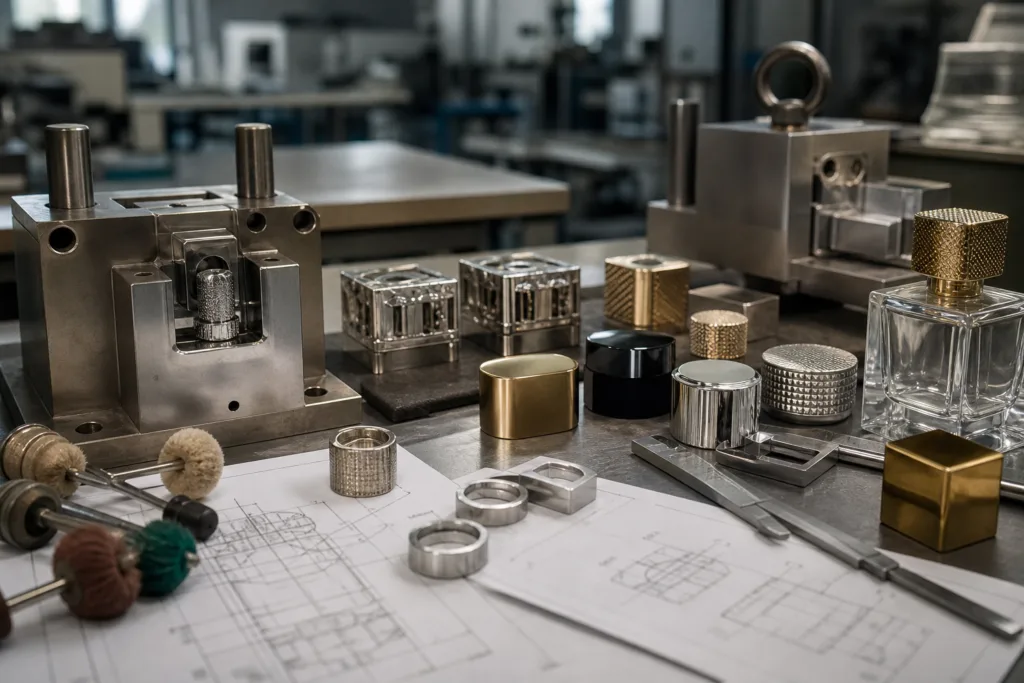
Buyers should look for a disciplined sample development process for perfume caps that includes specification confirmation, drawing review, finish reference alignment, and approval comments. If a supplier sends a sample without documenting what was changed or what remains provisional, the risk of mismatch in bulk production increases.
A useful sample approval workflow typically includes:
- Confirm bottle or neck sample receipt
- Confirm cap dimensions and target weight
- Confirm logo artwork format and position
- Confirm finish standard or color reference
- Review sample photos before shipment when needed
- Test sample fit on real bottle assembly
- Record approval comments for the next revision or bulk run
Communication quality during sampling is one of the best indicators of future production performance. If the supplier is vague about insert structure, finish variation tolerance, or sampling limits, the same communication problem may continue during mass production.
| Sample checkpoint | What to verify | Why it matters |
|---|---|---|
| Outer shape | Matches approved design intent | Avoids visual mismatch after tooling |
| Weight and balance | Feels premium and stable | Affects user perception and usability |
| Bottle fit | Proper insertion and pull-off force | Prevents loose or overly tight assembly |
| Finish quality | Color, gloss, polish, texture consistency | Sets realistic bulk expectation |
| Logo clarity | Depth, contrast, position, sharpness | Protects brand presentation |
| Packing method | Scratch prevention and separation | Reduces transit damage |
QC documentation and production capability
Quality control should be visible before the order is placed. Buyers should not wait until the bulk order is finished to ask how dimensions, finish defects, and assembly fit are checked. A reliable supplier should be able to explain inspection points, defect handling, and approval standards in plain terms.
We recommend asking for documented or clearly described quality control checkpoints for perfume cap production before confirming a purchase order. This helps buyers understand whether the supplier checks raw castings, polished surfaces, plated or painted appearance, insert assembly, final fit, and packed goods.
Useful QC questions include:
- How are critical dimensions identified and measured?
- How is finish consistency checked across a batch?
- How are plating defects, paint marks, or polishing scratches sorted?
- How is logo clarity approved?
- How is fit tested with the actual bottle or neck gauge?
- How are rework and replacement decisions made?
- How are finished caps packed to reduce abrasion?
For decorative metal caps, process discipline matters because one early defect can affect later steps. Poor polishing can remain visible under bright plating. Weak surface preparation can reduce coating adhesion. Incorrect insert dimensions can create a fit issue even if the outer cap looks perfect. That is why buyers should evaluate production capability, not only final sample appearance.
Key takeaway: The safest supplier is usually the one that can explain both how the cap is made and how mistakes are prevented before shipment.
When marketplace sellers can still be a practical option
Marketplace sellers are not always the wrong choice. They can be useful for early benchmarking, simple standard caps, small trial buys, or projects where no custom mold, no special insert, and no tight branding requirement is involved.
They may also help buyers quickly compare visual styles across many suppliers. For procurement teams in the idea stage, that speed can be valuable. But once the project moves into custom fragrance packaging, the buyer should verify who actually owns production, who handles tooling revisions, and who will take responsibility if the cap does not fit or the finish shifts in bulk.
Marketplace sourcing is usually more suitable when:
- The cap is based on an existing standard design
- The order quantity is small and low risk
- The finish is simple and easy to reproduce
- The buyer does not need custom logo placement or bottle fit engineering
- The project is a short-term test rather than a long-term brand line
Even in these cases, ask whether the seller is a factory, a trader, or a mixed business model. That answer affects the speed and credibility of technical responses later.
Common mistakes that increase sourcing risk
Most perfume cap sourcing problems are preventable. They usually come from incomplete specifications, unrealistic approval assumptions, or choosing a supplier based on photos and unit price alone.
| Mistake | Likely consequence | Better approach |
|---|---|---|
| Approving from photos only | Unexpected fit or finish problems | Approve physical samples on real bottles |
| Ignoring insert specification | Loose cap or excessive pull force | Confirm neck dimensions and insert structure early |
| Comparing quotes without process detail | Hidden quality or lead time risk | Compare tooling, finish route, MOQ, QC, and packing |
| Using vague finish descriptions | Color or gloss mismatch | Provide finish references and approval criteria |
| Skipping carton and packing review | Transit scratches or mixed SKUs | Confirm export packing logic before production ends |
| Late artwork revisions | Sampling delays or tooling changes | Freeze artwork and logo details before final sample |
From our experience, the highest-value prevention step is simple documentation. A concise specification sheet with bottle details, finish reference, logo file, quantity plan, and approval comments often prevents more problems than long email chains.
How buyers can make a better final sourcing decision
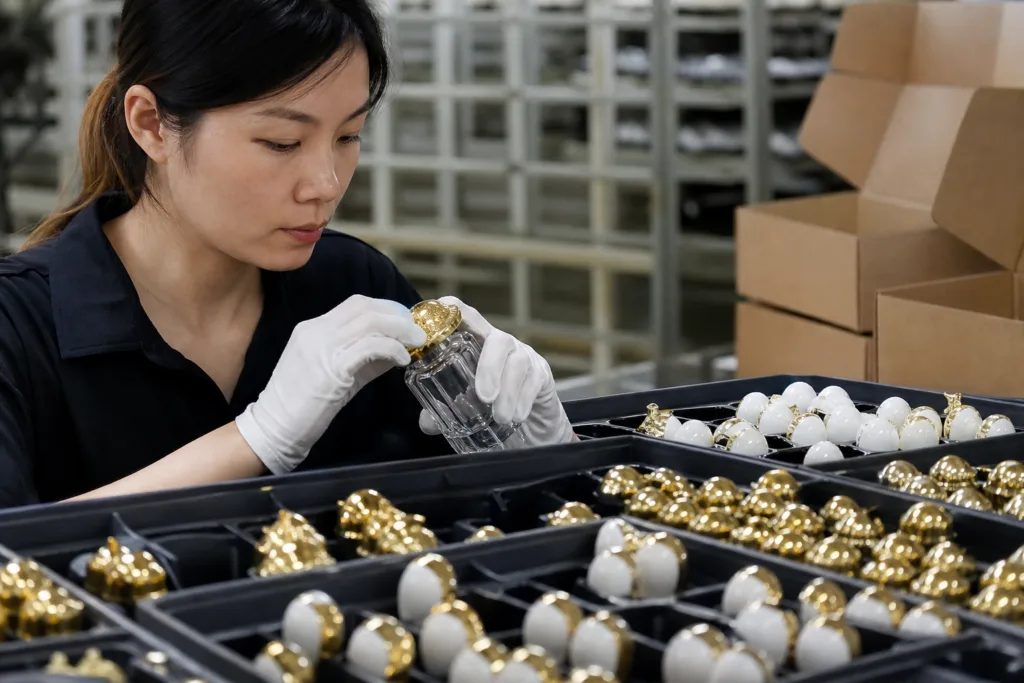
A good sourcing decision balances price, customization depth, communication quality, and operational reliability. Direct factories usually win when the project is custom, finish-sensitive, or intended for repeat production. Marketplace sellers may still help at the research or low-complexity stage, but buyers should understand where control ends.
Before choosing a supplier, we suggest scoring them across practical criteria rather than relying on one quote or one sample photo.
| Decision criterion | Questions to ask |
|---|---|
| Factory access | Can the supplier explain tooling, finishing, and QC directly? |
| Customization capability | Can they support custom shape, logo, insert, and finish combination? |
| Sampling discipline | Do they document revisions and approval points clearly? |
| Production control | Can they explain dimensional checks, finish sorting, and packing? |
| MOQ realism | Is MOQ aligned with process complexity and finish requirements? |
| Lead time credibility | Can they break down the production schedule logically? |
| Export readiness | Can they manage packing lists, labeling, and shipment coordination? |
If your fragrance packaging project needs custom decorative metal caps, bottle fit review, structured sampling, and repeatable bulk quality, working directly with Perfume bottle cap manufacturers is usually the more secure path. The cost conversation becomes more realistic, and the risk conversation becomes more transparent.
At Caps Ltd, we see the best outcomes when buyers share complete information early and evaluate suppliers on manufacturing fit, not only quotation speed. That approach supports better molds, better finish alignment, better sample approvals, and fewer surprises in bulk production.
Conclusion
The choice between a direct factory and a marketplace seller should follow the complexity of your perfume cap project. If the order is simple, standard, and low risk, a marketplace route may be acceptable. If the cap is custom, branded, weight-sensitive, finish-critical, or tied closely to bottle compatibility, direct Perfume bottle cap manufacturers usually provide stronger control over tooling, quality, communication, and delivery preparation.
For fragrance brands, private label teams, and packaging distributors, the safest sourcing strategy is to ask deeper questions early. Confirm fit, finish, mold logic, sample approval, MOQ assumptions, QC checkpoints, and export readiness before the order is placed. That is how buyers reduce packaging risk and build more dependable supply relationships.
FAQs
Should I buy perfume bottle caps from a manufacturer or a marketplace seller?
You should usually choose a manufacturer for custom or quality-sensitive projects. A direct factory typically offers better control over tooling, bottle fit, finish consistency, sampling, and bulk production communication, while a marketplace seller may be more suitable for simple standard caps or early supplier screening.
What is the biggest advantage of working with direct perfume bottle cap manufacturers?
The biggest advantage is process control. Direct manufacturers can usually explain material choice, mold changes, insert structure, finishing steps, quality checks, and lead time risks more clearly, which helps buyers make better decisions and reduce problems during sampling and production.
How can I tell if a perfume cap supplier is a real factory?
You can tell by asking technical and process-specific questions. A real factory should be able to discuss mold ownership, cap structure, dimensional tolerances, finish route, sample revisions, inspection points, and export packing methods with practical detail instead of only offering prices and product photos.
Why does bottle fit matter so much in perfume cap sourcing?
Bottle fit matters because an attractive cap can still fail if the insert structure does not match the bottle neck or collar correctly. Poor fit can cause loose assembly, excessive pull force, tilting, or customer dissatisfaction, so buyers should confirm bottle samples or exact neck specifications before final sampling.
What should I approve before placing a bulk order for custom perfume caps?
You should approve the physical sample, cap dimensions, weight, fit, logo treatment, finish standard, packing method, and written production notes before bulk production starts. This creates a practical reference for both sides and reduces the chance of disagreement later.
How do MOQ and lead time change between standard caps and custom caps?
MOQ and lead time are usually higher for custom caps because they may involve new molds, custom inserts, special finishes, logo tooling, and more inspection work. Standard caps can move faster when the mold and process are already established, but buyers should still confirm finish availability and packing requirements.