
Custom perfume bottle caps do more than complete the look of a fragrance bottle. For brand owners, private label teams, and packaging buyers, they influence perceived quality, hand feel, branding clarity, and day-to-day compatibility with the bottle and pump system. When buyers compare custom perfume bottle caps, the right decision usually comes from balancing design ambition with material choice, fit engineering, surface finish control, and a supplier’s ability to deliver consistent bulk production.
If your project is moving from concept into sourcing, it helps to review custom perfume bottle cap manufacturing support early so design direction, bottle compatibility, finish expectations, and sampling steps are aligned before quotation and tooling begin. For fragrance packaging projects with custom shapes, decorative metal finishes, logo treatments, or private label launch timelines, we typically advise buyers to confirm bottle data, target cap weight, branding method, and approval priorities before mold work starts.
What Custom Perfume Bottle Caps Are and Why They Matter in Fragrance Packaging
A custom cap is developed to match a specific bottle, brand identity, and packaging objective rather than being selected from a standard stock shape. That customization may involve the cap silhouette, weight, insert structure, finish, logo presentation, or decorative detailing. In fragrance packaging, this matters because the cap is one of the first components the customer sees and touches.
From our manufacturing perspective, the cap has to solve two jobs at once. It must support the visual language of the fragrance line, and it must also fit the bottle reliably in production and final assembly. A cap that looks premium but fits inconsistently creates launch risk, rework, and quality complaints.
Brands often choose custom caps when they want stronger shelf differentiation, a heavier and more deliberate hand feel, or a closer match to the bottle architecture. This is especially common in luxury fragrance packaging, limited edition projects, and private label collections where the outer presentation needs to justify a more premium position.
Key takeaway: Buyers should treat the perfume cap as both a branding component and an engineered packaging part. Ignoring either side usually leads to avoidable development delays.
How to Choose Materials and Structures for Custom Perfume Bottle Caps
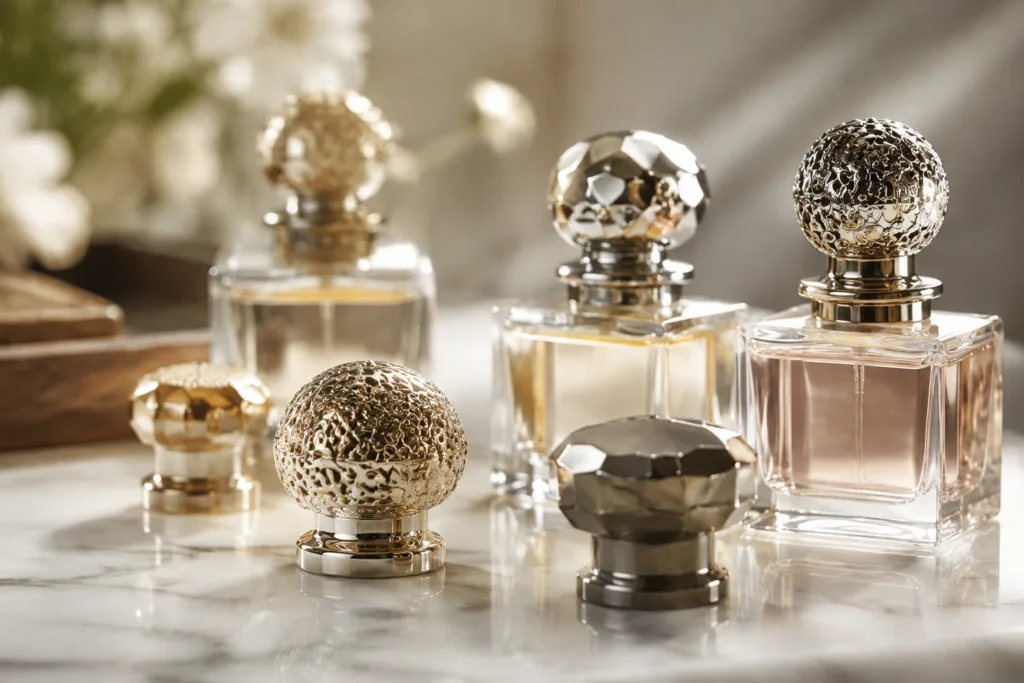
Zinc alloy is one of the most common choices for decorative metal perfume caps because it supports detailed shapes, substantial weight, and a premium surface after polishing and finishing. Compared with lightweight plastic constructions, zinc alloy gives a more solid hand feel and often helps brands communicate quality through touch as well as appearance.
That said, a heavier cap is not automatically the right cap. Weight affects shipping, assembly behavior, magnet selection when used, and how the cap balances on the bottle. If the bottle is slim or top-heavy, too much cap weight can affect handling and overall package stability.
We often discuss structure before finish, because internal construction determines whether the decorative shell will work reliably with the insert and bottle system. Buyers may focus first on the outside appearance, but the inside geometry is what controls repeatable fit.
| Material or Structure | Typical Advantage | Trade-Off to Review | Best Fit Scenario |
|---|---|---|---|
| Zinc alloy decorative cap | Premium weight, strong shape detail, high-end finish potential | Higher tooling and finishing complexity than simple plastic caps | Luxury, niche, and differentiated fragrance packaging |
| Lightweight plastic-based cap | Lower weight and often lower unit cost | Less premium hand feel and more limited metal-like perception | Cost-sensitive or high-volume entry projects |
| Heavy metal cap construction | Very strong tactile impact and premium perception | Must be matched carefully to bottle balance and logistics needs | Statement packaging and limited editions |
| Magnetic cap system | Controlled placement feel and elevated user experience | Requires more engineering attention and component coordination | Premium projects with a defined bottle and pump system |
| Standard friction-fit cap | Simpler construction and easier sourcing path | Less dramatic opening and closing experience | Mainstream custom fragrance programs |
For many custom projects, zinc alloy offers the best balance between shape freedom, decorative quality, and premium feel. It is especially useful when buyers want sharper geometry, logo relief, polished edges, or electroplated surfaces that are difficult to achieve at the same level with simpler constructions.
At Caps Ltd, we usually guide buyers to compare material and internal structure at the same time instead of treating them as separate decisions. That approach reduces the risk of approving an attractive cap concept that later becomes difficult to fit, plate, paint, or mass produce.
What Buyers Should Specify Before Requesting a Quote
A vague RFQ almost always creates avoidable back-and-forth. Before asking for pricing, buyers should define the cap shape, approximate size, target weight, logo position, finish direction, bottle type, expected order volume, and whether the project needs new tooling or adaptation from an existing structure.
The most useful quotation packages usually include bottle drawings or bottle samples, reference images, logo artwork, finish references, target launch timing, and the expected market position. A supplier can quote faster and more accurately when the aesthetic objective and fit requirements are both clear.
Design details that affect development speed
- Overall cap profile, top shape, and edge treatment
- Branding method such as engraving, embossing, debossing, or printed treatment
- Target finish such as bright plating, satin plating, matte paint, gloss paint, or mixed finishes
- Preferred weight range and hand-feel expectation
- Insert type, magnetic requirement, and bottle neck compatibility
- Packaging requirements for samples, export cartons, or assembled presentation
Logo treatment deserves more attention than many buyers initially expect. Small changes in logo depth, line thickness, and position can strongly affect visibility after plating or paint. Fine artwork that looks clear on screen may lose definition if the recessed or raised details are too shallow for the selected finish.
Finish choice also changes how surface defects appear. Electroplated perfume caps tend to reveal polishing quality more clearly, while painted perfume caps depend heavily on surface preparation, paint control, and color approval. Buyers planning a signature metal look should also be ready to discuss polishing standards and visual acceptance criteria, not only color names.
| Finish Option | Visual Effect | What Buyers Should Check | Common Risk |
|---|---|---|---|
| Bright electroplating | Reflective, luxury metal appearance | Base polishing quality, plating consistency, edge clarity | Surface defects become more visible |
| Satin or matte plating | Subtle metallic look | Texture consistency and color uniformity | Variation between sample and bulk finish tone |
| Baked paint | Broader color range and brand-specific matching | Color standard, coating adhesion, rub resistance | Mismatch between reference and production lot |
| Mixed finish treatment | Premium contrast and design depth | Masking accuracy and transition cleanliness | Complexity increases cost and lead time |
If the project requires a new shape, buyers should expect tooling discussion early. Clear shape references and bottle data make mold development for custom perfume cap projects more predictable and reduce the chance of repeated sample revisions caused by missing dimensions or unconfirmed branding details.
How Bottle Fit Engineering Prevents Costly Cap Problems
Fit engineering is one of the most important parts of custom cap development. A cap is not successful simply because it looks correct in a rendering or sits loosely on a sample bottle during an early concept review. It has to work with the actual neck finish, pump, collar, actuator area, insert structure, and assembly tolerances that will appear in production.
In practice, buyers should confirm bottle neck dimensions, closure geometry, insert material, and assembly method before approving final cap structure. When those details are delayed, the risk moves downstream into sample failure, fit inconsistency, scratched surfaces, loose retention, or overly tight removal force.
We recommend sending real bottle samples whenever possible, not only drawings. Technical drawings are essential, but a physical bottle often reveals practical issues involving neck variation, collar transitions, pump height, or decoration stack-up that are easy to miss on paper. This is why bottle fit engineering support for custom caps should be part of the sourcing conversation before final approval, not after tooling is complete.
For buyers building approval standards, it is useful to think in terms of dimensional control, retention force, insertion depth, alignment, and repeatability across multiple bottles. FDA guidance on packaging component dimensional criteria, tolerances, and closure quality control is a helpful reference point for why component drawings, tolerance review, and incoming inspection matter when closure compatibility is part of overall packaging performance.
What manufacturers usually need for fit checks
- Bottle sample and pump or spray assembly sample
- Neck finish drawing and key dimensions
- Target cap height and external design concept
- Insert preference or performance expectation
- Any pull-force, alignment, or opening-feel requirement
- Assembly sequence and whether caps ship assembled or separately packed
Key takeaway: Bottle fit problems are usually more expensive to solve after finishing or tooling than during the design review stage. Buyers save time when they define compatibility requirements early.
When Electroplating Is Better Than Painted Finish
Electroplating is usually the better choice when the brand wants a true metallic appearance, crisp reflectivity, and a heavier luxury expression. Painted finishes are often better when color matching is the priority, especially for specific brand shades that cannot be achieved reliably through plating tone alone.
Neither finish is universally superior. The right choice depends on the product concept, handling expectations, budget, and the tolerance for visual variation. In our experience, buyers make better decisions when they evaluate finish choice against use conditions and approval criteria instead of selecting only from a mood board.
| Comparison Point | Electroplated Cap | Painted Cap |
|---|---|---|
| Main strength | Metallic depth and premium visual impact | Flexible color matching and broader tone options |
| Critical process factor | Polishing and plating consistency | Surface preparation and coating control |
| Common approval focus | Brightness, uniformity, and edge clarity | Color match, coverage, and coating adhesion |
| Risk to watch | Surface defects showing through finish | Color variation or coating wear in handling |
| Typical use case | Luxury metal appearance | Brand color-driven packaging |
Polishing quality matters especially for plated metal caps because the final finish reflects the quality of the base surface. Scratches, pits, and uneven preparation can remain visible after plating. For durability discussions, buyers should also understand that comparative testing such as ASTM salt spray corrosion testing for coated metal parts is often used to screen finish resistance, but it should be treated as one controlled QC indicator rather than a complete prediction of real-world performance.

Painted caps require their own discipline. Color standard approval, gloss level confirmation, coating adhesion, and packaging protection all need to be reviewed carefully. A good sample does not guarantee good bulk output unless the production controls are stable and the acceptance standard is documented clearly.
How Weight, Balance, and Hand Feel Influence Premium Perception
Cap weight is not just a cosmetic preference. It changes how the bottle feels in hand, how confidently the package is perceived, and how the user experiences opening and replacing the cap. A premium fragrance line often benefits from a more deliberate, weighty cap, but the cap should still feel proportionate to the bottle.
We usually advise buyers to compare cap weight with bottle size, glass thickness, and intended market position. A compact bottle can feel awkward if the cap dominates the package. On the other hand, an underweight cap on a high-value fragrance bottle may weaken the tactile impression even if the visual design is attractive.
This is where sample evaluation becomes essential. Reviewing hand feel only from a drawing or weight target is not enough. Buyers should handle assembled samples and check whether the cap removal force, seating feel, and overall balance match the desired user experience.
What MOQ, Lead Time, and Bulk Planning Really Depend On
MOQ and lead time are rarely fixed numbers across all perfume cap projects. They depend on whether the cap uses existing tooling or new mold development, the complexity of the shape, the finish type, the logo treatment, the insert structure, and the packaging requirements for export.
Buyers who need bulk quantities should clarify timeline expectations early, especially if the project includes new decorative metal tooling, special color approval, or mixed finish treatment. It is common for custom projects to require longer preparation than stock packaging components because more steps have to be validated before production release.
When procurement teams are aligning a fragrance launch calendar, lead time and MOQ planning for bulk cap orders should be discussed together with sampling milestones, not as a separate commercial issue. MOQ affects unit economics, while lead time affects bottle ordering, filling schedules, packing materials, and market release coordination.
| Planning Factor | What It Changes | Buyer Action |
|---|---|---|
| New mold required | Longer development cycle and higher upfront cost | Approve design direction early and send complete bottle data |
| Complex finish | More sample iterations and tighter QC needs | Define finish standard and approval limits clearly |
| Low initial volume | Can affect feasibility or unit cost | Discuss forecast and repeat potential honestly |
| Export packing needs | Changes carton planning and protection method | Share shipping method and packaging expectations |
| Private label timing | Compressed milestones across multiple packaging parts | Align cap development with the full packaging calendar |
For wholesale-style buyers and packaging distributors, the practical question is not only price per cap. It is whether the supplier can hold finish consistency, manage packaging protection, and support repeated production across future batches.
How to Evaluate a Custom Perfume Cap Manufacturer
A strong supplier should be able to translate a design idea into a manufacturable cap structure, verify bottle compatibility, manage sampling, and maintain finish consistency in mass production. Buyers should evaluate technical capability and communication quality together, because a technically capable factory can still create delays if project information is not handled clearly.
The most useful supplier review often comes from asking process questions. How will the cap fit be validated? What drawings are required? How are plating and paint standards approved? What is checked before bulk packing? How are dimensional and appearance issues controlled lot to lot?
Buyer checklist for supplier evaluation
- Can the supplier review bottle drawings and actual bottle samples?
- Do they explain insert structure and fit logic clearly?
- Can they support logo treatment, polishing, plating, or paint approval with samples?
- Do they define production checkpoints before mass output?
- Can they explain export packaging protection for finished caps?
- Are communication timing and revision handling realistic?
From our decorative metal cap production perspective, the most successful programs usually start with disciplined communication. Buyers who provide complete artwork, bottle data, target volumes, finish references, and launch timing tend to move through development more smoothly than teams that try to finalize key details after sampling has already started.
It is also reasonable to ask for visibility into quality control checkpoints for perfume cap production. The exact system will vary by project, but buyers should expect checks related to dimensions, finish appearance, logo clarity, fit, assembly behavior, and packaging condition before shipment.
Common Mistakes That Cause Delays or Inconsistent Results
Most cap problems are not caused by one dramatic failure. They usually come from small missing decisions that compound across design, tooling, finishing, and assembly. Buyers can avoid many of them by treating the cap as a technical packaging project rather than a decorative accessory alone.
| Common Mistake | Likely Consequence | Better Approach |
|---|---|---|
| Requesting quotation without bottle data | Inaccurate assumptions about fit and structure | Provide bottle drawings or bottle samples first |
| Approving finish without a clear standard | Sample-to-bulk visual disputes | Define gloss, tone, texture, and acceptable variation |
| Focusing only on external shape | Late insert or retention problems | Review internal construction early |
| Choosing excessive cap weight for a small bottle | Poor balance and handling issues | Test assembled samples in hand |
| Underestimating tooling and sampling time | Launch schedule pressure | Build realistic development milestones |
Key takeaway: The best custom cap projects are usually the ones with the clearest early specifications, not the most complicated visual concepts.
When a Product Page Is Better Than a General Article

Some users searching online are not comparing sourcing strategy. They already know they need a custom metal cap, a zinc alloy cap style, or a private label fragrance packaging solution and want to move directly toward sampling or quotation. In those cases, a focused product or service page is often more useful than a general buying guide.
That does not reduce the value of a guide like this one. A sourcing article helps buyers ask better questions, prepare more complete RFQ information, and compare suppliers on practical points such as fit engineering, finish control, MOQ planning, and export readiness. Once those questions are clear, the next step is usually a product-specific review and sample discussion rather than more general reading.
For buyers working on real launch timelines, the most efficient move is often to prepare bottle samples, logo files, finish references, volume expectations, and packaging requirements before requesting a formal quotation. That makes the transition from research to development much faster.
Conclusion
Choosing custom perfume bottle caps is ultimately a packaging decision that combines branding, engineering, and production control. The most successful buyers do not evaluate the cap only by appearance. They compare material and weight, validate bottle fit, define finish expectations, review sample quality carefully, and confirm that the supplier can manage repeatable bulk output.
From our experience, projects move more efficiently when buyers share complete technical and visual information early, especially for zinc alloy caps, luxury decorative finishes, and private label fragrance programs. When the cap design, bottle compatibility, and approval standards are aligned from the start, development becomes more predictable and supplier selection becomes easier to defend internally.
Frequently Asked Questions
What is the most practical material for custom perfume bottle caps?
Zinc alloy is often the most practical material for premium custom perfume caps because it supports detailed shapes, substantial weight, and decorative finishing options. It is especially suitable when buyers want a luxury hand feel, crisp logo treatment, and electroplated or polished metal surfaces, but the final choice should still reflect bottle balance, target cost, and finishing complexity.
How do buyers confirm whether a cap will fit the bottle correctly?
Buyers should confirm fit by providing bottle drawings, pump or spray details, and ideally physical bottle samples for evaluation. A reliable fit review considers neck dimensions, insert structure, insertion depth, retention behavior, and production tolerances rather than checking appearance alone on a concept sample.
Is electroplating better than paint for perfume caps?
Electroplating is better when the goal is a true metallic look with strong reflectivity and premium visual depth, while paint is better when exact brand color matching is the priority. The right option depends on the design intent, expected handling conditions, and the supplier’s ability to maintain consistent surface preparation and finish approval standards.
What should be included in an RFQ for a custom perfume cap project?
An effective RFQ should include bottle samples or bottle drawings, target cap dimensions, design references, logo artwork, finish direction, expected order quantity, and timeline expectations. The more clearly buyers define fit, appearance, and production priorities at the start, the more accurate the quotation and sampling plan will be.
Why do custom perfume cap projects have different MOQs and lead times?
MOQs and lead times vary because each project can involve different tooling needs, surface finishes, insert structures, and packaging requirements. A cap using new molds and complex plating or paint approval will usually require more development time than a simpler structure adapted from an existing manufacturing base.
How should buyers compare custom perfume cap manufacturers?
Buyers should compare manufacturers on engineering support, bottle fit validation, finish control, sample quality, communication clarity, and bulk production inspection methods. A supplier is more reliable when they can explain how they manage tolerances, logo definition, assembly compatibility, packaging protection, and repeat consistency across production lots.